Not every training moment needs a full video simulation. Sometimes the most effective practice is a conversation: typed, on demand, and focused on exactly the skill a learner needs to develop right now.
Virti's AI role play chat gives every team a lightweight, flexible way to practise realistic conversations at scale. No scheduling. No setup time. No colleague pretending to be a difficult prospect. Just meaningful role play training that builds confidence and capability before the real moment arrives.
Whether you lead a sales team, run a contact centre or shape leadership development across your company, this guide shows how chat role play works, why it builds skills that stick, and where teams are getting the most value from it.
Your Learning Path
- What chat role play is and how Virti's AI makes it feel like a real conversation
- Why realistic scenarios, psychological safety and constructive feedback matter
- Eight ways teams use Virti for role play, from sales role plays to clinical communication
- How sales managers turn role play into a regular habit
- How to get started with your first scenario
What Is Chat Role Play?
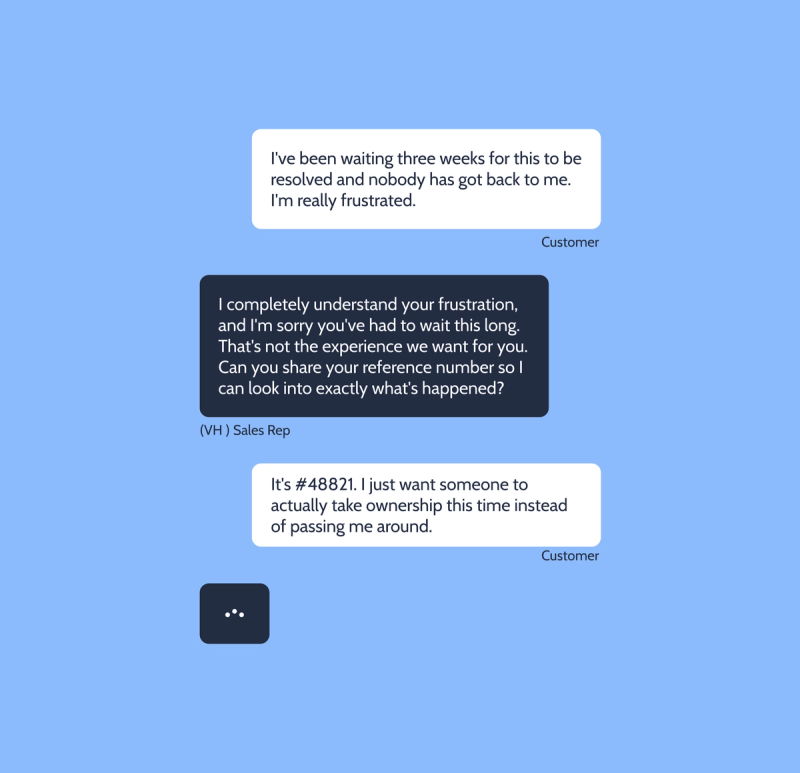
Chat role play is conversation practice through text. The learner types their response, and an AI character replies in real time, reacting to what was actually said rather than following a fixed script. The character might be a prospect with a tight budget, a frustrated customer, an anxious patient or a team member who disagrees with a decision.
Because the AI responds dynamically, no two role plays are quite the same. Push too hard and the prospect pulls back. Ask a sharp question and they open up. That unpredictability is what turns a simple text chat into practice that mirrors real customer interactions.

Why AI Role Play Works
Traditional role playing exercises depend on a manager or peer having time to play the other side, and on everyone feeling comfortable performing in front of colleagues. AI role play removes both barriers. Learners can practise whenever they have ten minutes, as many times as they need, and the AI never gets tired, never goes easy and never forgets to give feedback.
It also works alongside the other tools in your training stack. Most learning tools, including your learning management system, are built to deliver knowledge. Virti gives people a place to apply that knowledge in conversation, which is where skill development actually happens.
Why Regular Practice Builds Lasting Skills
Knowing what to say and being able to say it under pressure are two different skills. The gap between them closes through regular practice, not one off workshops. Here is what makes chat role play on Virti so effective.
Realistic Scenarios Built Around Actual Challenges
Generic scripts produce generic results. Virti scenarios are built from your own content, so learners face the actual challenges they meet every day: the real world objections your reps hear, the complaints your agents handle, the conversations your managers find hardest. Realistic scenarios make practice feel relevant, and relevance is what keeps people coming back.
Feeling Safe and Building Trust
People learn faster when they are free to get it wrong. Practising with an AI character gives learners psychological safety: a private space to try a new approach, make mistakes and try again without an audience. That safety also helps teams establish trust in the process, because role play stops feeling like a test and starts feeling like preparation.
Constructive Feedback After Every Session
Practice without feedback is just repetition. After every session, Virti delivers specific, objective feedback on what the learner said and how they said it, highlighting strengths as well as identifying areas to improve. Constructive feedback like this is immediate and consistent, so learners know exactly what to focus on next time.
8 Ways Teams Use Virti for Role Play Training
1. Sales Objection Handling
Objections don't wait for the perfect moment. A prospect raises a budget concern halfway through a pitch, pushes back on value or compares you to another option, and the rep has to respond with confidence and clarity.
Virti lets sales reps practise exactly those moments on demand. They can run through the same objection several times with different approaches, refine their language and build the instinctive response that only comes from repetition. Sales managers can assign specific objection scenarios based on what is costing the team deals right now, and track how each rep's responses develop over time.
It is also one of the fastest ways to onboard new reps. Rather than learning how to deal with pushback on live calls, they arrive having already rehearsed the hardest conversations dozens of times. In one global sales pilot, reps completed an average of 32.5 voluntary practice sessions each, proof that when sales role plays feel realistic, people choose to practise.

2. Discovery Calls and Probing Questions
Great discovery is the foundation of every deal that closes. But most reps default to the questions they are comfortable with rather than the ones that surface real pain. Chat role play creates space to practise going deeper: following the prospect's agenda rather than a script, asking probing questions beyond surface answers and staying curious when the conversation goes somewhere unexpected.
Virti's AI powered Virtual Humans respond to what the rep actually asks, so the practice reflects the unpredictability of real sales situations. Reps can rehearse conversations with different decision makers, from a cautious finance lead to a busy operations director, and learn to adapt in the moment rather than rely on a prepared list that stops working as soon as the prospect changes direction.
3. Customer Service and Difficult Conversations
Calming an angry customer is one of the hardest service skills to train because it requires composure under real emotional pressure. A script helps. Role play under realistic pressure helps more.
Virti puts agents in the middle of difficult customer interactions: the repeat contact who has run out of patience, the complaint that escalates when it should resolve, the customer who refuses to be satisfied. Because the AI customer responds to how the agent handles each moment, the practice is challenging rather than a box ticking exercise. Agents learn what defuses tension and what makes it worse, long before they are dealing with it live.
4. Leadership and Management Conversations
The conversations that define great leadership are also the ones most leaders avoid practising. Delivering difficult feedback. Managing underperformance. Navigating conflict between team members. Communicating through change.
Chat role play gives managers a private, low pressure environment to work through exactly these moments. They can explore different approaches, practise providing feedback that is honest without being harsh, and build the language that makes a hard conversation land well. Because every session generates performance data, L&D teams can see which leadership conversations cause the most difficulty across the organisation and direct coaching where it is needed most.
5. New Hire Onboarding
The gap between completing onboarding and being ready to perform is where most new hires lose confidence. They know the product. They understand the process. But they have never had the conversation.
Chat role play closes that gap. New hires can practise their first customer call, their first tricky question and their first attempt to explain your value proposition before any of it happens live. Built from your existing onboarding content, the scenarios use your organisation's real language and situations from day one, so new starters arrive at their first live interaction having already been in it several times.

6. Compliance and Policy Conversations
Compliance training is often where engagement goes to die: click through modules and annual assessments that test knowledge without ever testing whether someone can apply it.
Instead of asking whether a learner knows the policy, Virti asks whether they can navigate a real conversation where the policy matters: a client asking for something outside the rules, a situation where the right answer is not obvious, a moment where tone matters as much as content. The practice is more engaging because it is realistic, and more effective because applying knowledge under pressure is what compliance actually requires.
7. Healthcare and Clinical Communication
Clinical competence and communication competence are not the same thing. A clinician can know exactly what a patient needs and still struggle to explain it in a way the patient understands and trusts.
Chat role play gives clinical teams a way to practise the conversations that carry the highest stakes: breaking difficult news, explaining a complex diagnosis, supporting a patient who is confused or distressed, all without any risk to real patients. It is especially useful for situations that arise rarely but require immediate confidence when they do. And because practice scales without actors or facilitators, Virti has delivered a 91% cost reduction in healthcare simulation.

8. Soft Skills Across Every Team
The skills hardest to develop through traditional training, such as empathy, active listening, communication skills and adaptability under pressure, are exactly the skills chat role play builds best.
Because every session is a real conversation rather than passive content, learners are practising the skill itself rather than studying it. Virti can be deployed in any team where communication matters, from HR and finance to retail and hospitality, with scenarios built around each team's unique needs and updated instantly as your business evolves. It is role play training that fits into the working day rather than being extracted from it.
How Sales Managers Use Chat Role Play
Sales is where chat role play often delivers its fastest return. Every sales role carries its own mix of conversations, and the reps who close more deals are usually the ones who have rehearsed them most. Here is how sales managers and sales professionals get the most from Virti.
Running Sales Role Plays at Scale
Live role playing exercises in a team meeting are valuable, but they are hard to schedule and only one rep practises at a time. With Virti, everyone on the sales team can run role plays on their own schedule, against the same realistic scenarios, with consistent feedback. For example, a manager might build one scenario for handling objections on price, another for a renewal conversation and a third for a first meeting with senior decision makers at a new prospect.
Making Role Play Part of the Weekly Routine
The biggest gains come from little and often. Short sessions a few times a week build stronger selling instincts than a single workshop each quarter. Because practice takes minutes rather than hours, role play becomes a regular habit rather than an occasional event, and sales reps build confidence for real sales situations without stepping away from their pipeline.
Tracking Improvement and Coaching Closely
Virti gives managers a clear view of each rep's progress, so they can watch how skills develop, spot patterns across the sales team and coach closely where it counts. Instead of guessing who needs help, managers can see it in the data and tailor coaching to the specific needs of each of their sales reps. Ultimately, that is what turns role play into a powerful tool for closing deals: practice that is measured, targeted and connected to results.
How to Get Started With Chat Role Play on Virti
Getting started does not require a complex implementation or a long content build. With Virti, you can create your first scenario from a simple prompt or by uploading your existing training materials, scripts and frameworks. Scenarios are live in hours, not weeks.
Step 1: Identify Where the Gap Is Biggest
Start with the use case where the performance gap is most visible: the objection your sales team keeps losing, the customer interaction driving escalations or the leadership conversation your managers keep avoiding. A clear focus makes success easier to measure.
Step 2: Build One or Two Realistic Scenarios
Turn that gap into focused roleplay exercises using your own content. Keep the first scenarios tightly defined so learners can see what good looks like and where they went wrong.
Step 3: Run a Pilot and Track the Results
Run your scenarios with a pilot group and let the data show where confidence is building and where gaps remain. From there, Virti handles the practice, responding dynamically to each learner, delivering feedback after every session and giving managers the visibility to coach without sitting in on every conversation. It is a simple strategy for scaling: prove the value with one team, then expand.

Before You Go
- Chat role play is one of the most flexible ways to build skills at scale: no scheduling, no setup, just meaningful practice on demand
- Sales role plays on Virti build the objection handling and discovery instincts that only come from repetition, before they are needed on live calls
- Customer service teams use AI role play to build composure for difficult conversations, and contact centre deployments have cut QA supervision hours by 80%
- Leadership teams use roleplay exercises to work through feedback, underperformance and conflict in a private, low pressure environment
- New hires close the gap between onboarding and performance by rehearsing their first live interactions in advance
- With Virti, scenarios are built from your existing content, updated instantly and available to any team where communication matters
Frequently Asked Questions
How is chat role play different from video simulation?
Chat role play is faster to set up, easy to access on any device and well suited to high volume practice where the focus is on language, reasoning and response quality. Video simulation with Virtual Humans adds facial expressions and emotional cues, which makes it especially powerful for high stakes interpersonal scenarios. Virti offers both, and the right choice depends on the use case. For rapid, repeatable practice at scale, text chat is often the faster and more flexible option.
Can scenarios be built from our existing training content?
Yes. You can upload your existing scripts, frameworks, objection logs, policy documents and training materials directly into Virti. Every scenario is grounded in your organisation's real content, so learners practise the conversations they actually have with clients and customers rather than generic situations. Scenarios can be updated instantly whenever your content changes, with no rebuild required.
How do we measure whether role play is improving performance?
Every Virti session generates performance data at individual and team level, showing how learners develop over time, where skill gaps persist and which scenarios drive the most improvement. Managers can see who is building confidence and who needs more support, and connect those insights to the business metrics that matter: sales results, customer satisfaction, onboarding speed and leadership behaviour change.
Is AI role play suitable for experienced sales professionals?
Absolutely. Experienced sales reps use Virti to rehearse high stakes conversations before they happen, such as a renegotiation with a key account or a pitch to a new buying committee. The AI can be configured to be as demanding as you need, so even your best performers are stretched rather than going through the motions.