Two colleagues stop speaking after a row over who owns a project. A manager puts off a performance conversation for the third week running. A customer's complaint turns into a personal attack on the agent handling it.
Workplace conflict rarely arrives as one big blow up. It builds in small moments that nobody feels confident handling, and left alone it drains productivity, morale and trust. Knowing the theory of conflict resolution helps. Practising the actual conversation is what changes how people respond.
That is what conflict resolution role play is for. Below are six realistic scenarios, each with an opening line to practise, plus how to run them with AI so every employee can rehearse the hard conversations before they happen for real.
Your Learning Path
What Is Conflict Resolution Role Play?
Conflict resolution is the process of addressing a disagreement constructively: identifying the root cause, understanding each person's perspective and working towards a solution both sides can accept, while keeping the working relationship intact.
Conflict resolution role play turns that process into practice. One person plays themselves and someone else plays the other party, working through a realistic disagreement so they can try different approaches safely. It is one of the most effective ways of teaching conflict resolution skills, because the hardest part of conflict is rarely knowing what to do. It is staying calm enough to do it.
The challenge with traditional role play is that it relies on a colleague or trainer playing the other side convincingly, and most people find it awkward. AI removes that barrier: a Virtual Human plays the other party, responds realistically to what you say and gives you feedback after every attempt.
The Conflict Resolution Skills to Practise
Every scenario below builds the same core skills. Keep these in mind as you practise.
Active listening
Give the other person your full attention, reflect back what you have heard and ask open questions before offering your view. Most conflict eases once people feel understood.
Staying calm under pressure
Keep a steady tone, pause before you respond, and acknowledge emotion without matching it. Practising this when nothing is at stake makes it far easier to do when everything is.
Finding common ground
Move from positions to interests. Ask what each person actually needs, then look for the solution that meets the most important needs on both sides, whether that is a compromise, a trade or a completely new option.
Clear, respectful communication
Describe behaviour and its impact rather than someone's personality. "The report arrived after the deadline" lands very differently from "you are always late".
6 Conflict Resolution Role Play Scenarios With Opening Lines
These scenarios reflect the conflicts that come up most often at work. For each one, practise the opening line first, then let the conversation unfold. With AI role play, the other party will push back, get defensive or open up depending on how you handle it.
1. Colleagues clashing over workload
Two team members are working on the same project. One feels they are carrying most of the work; the other feels micromanaged. The tension is starting to show in team meetings.
Opening line to practise: "I've noticed things have felt tense between us on this project, and I'd like to sort it out. Can we talk through how we've split the work?"
What good looks like: Each person describes the problem from their side without blame, and the conversation ends with a clearer split of responsibilities.
2. A manager and an underperforming team member
A team member's work has slipped over the past two months. Deadlines are being missed and quality has dropped. The manager has avoided raising it, and the team member may not realise how serious it is.
Opening line to practise: "I want to talk about how the last couple of months have gone. I've noticed some deadlines slipping, and I'd like to understand what's been happening from your side."
What good looks like: The manager is specific about the impact, listens before suggesting solutions, and agrees clear next steps with support in place.
Our guide to giving feedback with AI role play covers this conversation in more depth.
3. A team member who keeps interrupting
In meetings, one colleague regularly talks over others. Quieter team members have stopped contributing, and resentment is building.
Opening line to practise: "Can I grab you for a minute about yesterday's meeting? I noticed a few people didn't get to finish their points, and I wanted to talk about how we can make space for everyone."
What good looks like: The conversation focuses on the behaviour and its effect on the team, not the person's character, and ends with something specific to try in the next meeting.
4. A customer complaint that becomes personal
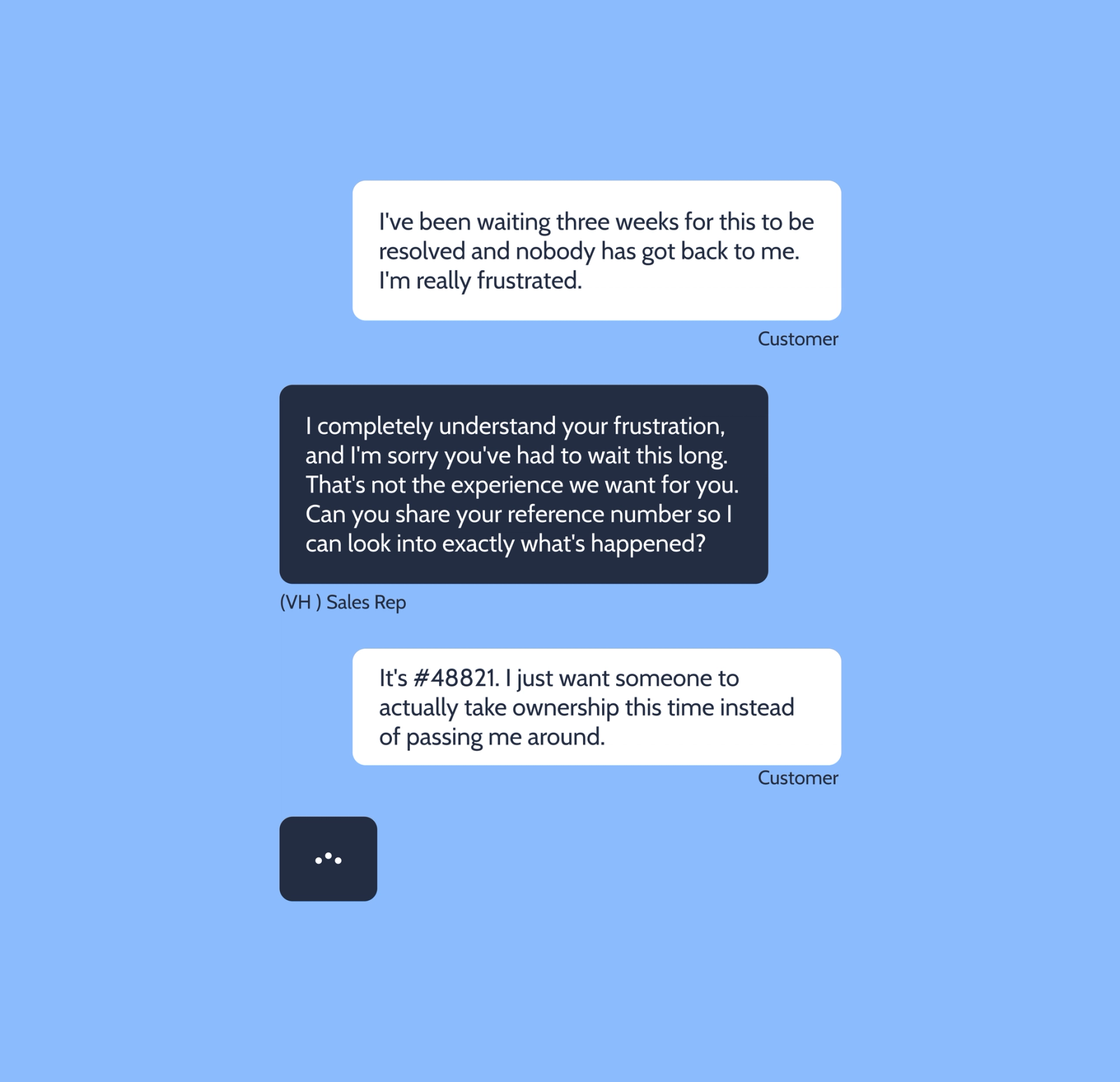
A customer's complaint about a delayed order escalates. They start blaming the agent personally and threatening to take their business elsewhere.
Opening line to practise: "I can hear how frustrating this has been, and I want to get it sorted for you. Let me check exactly where your order is right now."
What good looks like: The agent acknowledges the emotion, doesn't take the criticism personally, and steers the conversation towards a solution.
5. Two departments competing for limited resources
Sales wants marketing to prioritise a campaign for a key account, but marketing has already committed its budget elsewhere. Both department heads feel the other is ignoring their goals.
Opening line to practise: "We both want this quarter to land well, so let's start with what each of us needs to hit our targets and see where there's room to move."
What good looks like: Both sides share their constraints openly, find common ground in shared goals, and agree a compromise or a clear route to escalate.
6. Pushing back on your manager
Your manager has set a deadline you know is unrealistic. You are worried about saying no to someone more senior.
Opening line to practise: "I want to make sure we deliver this well. Based on what's involved, I don't think the current deadline is achievable. Can I walk you through what I'd need to hit it?"
What good looks like: The concern is raised early, framed around the shared goal, and comes with options rather than just a problem.

How AI Role Play Makes Conflict Resolution Training Scalable
Traditional conflict resolution activities, such as workshops and paired role play, are useful but limited. They depend on trainer time, they happen once or twice a year, and many people feel self conscious acting out conflict in front of colleagues.
With AI role play, each employee practises privately against a Virtual Human that reacts like a real person. If you stay calm and listen, it opens up. If you get defensive or dismissive, it pushes back. You can retry the same scenario with a different approach and see what changes.
After every session, feedback shows what you said against each skill you were assessed on, from active listening to agreeing a solution, so you know exactly what to practise next. Virti AI Coaching remembers every session, so its coaching builds on your progress over time.
For L&D and HR professionals, scenarios can be built from your own policies and real workplace situations, so practice reflects your organisation rather than generic examples. Managers can track progress across teams and see which conflict resolution skills need more support.
How to Get Started
Start with the conflict your teams find hardest. For most organisations, that is the manager and underperformer conversation or the customer complaint that turns personal. Build one or two scenarios around it, run them with a pilot group, and use the feedback data to see where confidence is growing.
Then expand. Add peer conflicts, cross department disagreements and upward conversations so people practise both sides of the situations they meet every day. Because conflict resolution sits at the heart of good management, these scenarios also fit naturally into your leadership development programme.
With Virti, you can build scenarios like these from a simple prompt or your existing training materials and have employees practising within hours.
Want to see it in action? Try a scenario with a Virtual Human and see how it responds to you.
Before You Go
- Conflict resolution role play lets people practise difficult conversations safely, so they stay calm when it matters
- Focus on four core skills: active listening, staying calm, finding common ground, and clear, respectful communication
- Practise realistic scenarios, from workload clashes and underperformance to customer complaints and pushing back on a manager
- Start each scenario with a strong opening line, then let the conversation unfold
- AI role play makes practice private, repeatable and measurable, with feedback after every attempt
Frequently Asked Questions
What is a conflict resolution role play?
A conflict resolution role play is a practice exercise where people act out a realistic workplace disagreement so they can rehearse how to handle it. One person plays themselves, and the other party is played by a colleague, a trainer or, increasingly, an AI Virtual Human.
What are good conflict resolution role play scenarios for work?
The best scenarios reflect real situations your teams face: colleagues clashing over workload, a manager addressing underperformance, a team member who keeps interrupting, a customer complaint that becomes personal, departments competing for limited resources, and pushing back on a manager.
How do you run a conflict resolution role play?
Set the scene clearly, agree the goal of the conversation and give the person practising an opening line. Let the conversation run for a few minutes, then debrief: what worked, what escalated the tension and what to try differently. Repeat the scenario so people can apply the feedback straight away.
Can AI help with conflict resolution training?
Yes. AI role play lets every employee practise conflict conversations privately with a Virtual Human that reacts realistically, then get specific feedback on their listening, tone and approach. It removes the awkwardness of acting out conflict in front of colleagues and makes regular practice possible at scale.