Most people prepare for public speaking. They write notes, rehearse in their head, and read through their slides the night before. And then they stand up and discover that knowing what they want to say and being able to say it clearly under pressure are two completely different things.
Preparation is not practice. Practice is saying it out loud, handling the unexpected, and doing it often enough that the anxiety stops interfering with the performance. Here is how to do that effectively.
Your Learning Path
- Why public speaking practice works differently to preparation
- What effective public speaking practice actually looks like
- The specific scenarios worth practising
- How AI roleplay makes public speaking practice more accessible
- How to build a practice habit that compounds over time
- How to get started
Why Practice Works Differently to Preparation
Preparation gives you something to say. Practice gives you the ability to say it: clearly, confidently, and without falling apart when something does not go to plan.
The distinction matters because the thing that makes public speaking hard is not lack of knowledge. It is the physiological response to being watched and judged: the dry mouth, the racing heart, the sudden inability to remember a point you have made a hundred times in conversation. That response does not diminish through understanding. It diminishes through exposure.
Every time you practise public speaking in conditions that feel like the real thing (standing up, speaking aloud, in front of an audience or a simulated one), you are teaching your nervous system that the situation is survivable. Over time, the response reduces. The words come more easily. The recovery from a stumble becomes faster. The confidence that looks natural from the outside is almost always the product of a great deal of private practice.
What Effective Public Speaking Practice Actually Looks Like
Effective practice has three characteristics that most preparation does not.
It is out loud
Reading through notes silently is not practice. Neither is rehearsing in your head. The physical act of speaking, forming the words, projecting your voice, managing your pace, is a skill that only develops by doing it. If you are not speaking out loud, you are not practising public speaking.
It includes the unexpected
The moments that most commonly derail a presentation are the ones that were not planned for: a challenging question, an interruption, a blank mind at the wrong moment. Practice that only covers the planned content does not prepare you for those moments. Effective practice includes scenarios where something goes off script and you have to adapt.
It involves feedback
Practising in a vacuum builds confidence but not necessarily competence. Knowing what landed, what did not, where the pace dropped, where the explanation lost clarity: that is the information that drives improvement. Practice without feedback is slower and less targeted than practice with it.
What to focus on in each session
Once you are practising aloud, give each session a focus. These are the delivery habits that make the biggest difference to how your message lands:
- Pace and pauses: slow down at your main points and use a deliberate pause to let them land.
- Filler words: notice the "um", "so" and "you know" that creep in when you are thinking on your feet.
- Voice: vary your tone and volume so your speech carries, rather than settling into one flat level.
- Body language and eye contact: stand still when you make a key point, and look at people rather than your slides.
Recording a five minute run through on your phone and watching it back is one of the quickest ways to spot all four.
Public Speaking Scenarios To Try
Different aspects of public speaking require different kinds of practice. Here are the scenarios that build the skills most people find hardest.
Explaining a complex idea clearly
The ability to take something technical, nuanced, or unfamiliar and explain it in a way that an audience without your expertise can follow is one of the most valuable public speaking skills, and one that almost nobody practises deliberately. Run through your explanation aloud and notice where you reach for jargon, where you assume knowledge the audience does not have, and where the logic loses its thread.
Handling a challenging question
Questions from an audience are the part of public speaking that most people dread most, because they cannot be scripted. The skill is not in having the perfect answer. It is in staying composed, buying time if you need it, and responding clearly without being destabilised by the question. Practise this by asking a colleague or an AI to put difficult questions to you until the composure becomes instinctive.
Responding to an interruption or pushback
Being challenged midway through a presentation, by a sceptical question, a contradicting data point, or someone who simply disagrees, requires a different kind of composure to handling a end of presentation question. The audience is watching, the flow is broken, and the instinct is either to capitulate or to become defensive. Practise acknowledging the challenge, responding to it briefly, and returning to your thread without either losing the room or losing your argument.
Recovering when you lose your thread
Almost every experienced speaker has lost their thread midway through a presentation. The difference between a recovery that the audience barely notices and one that derails the whole thing is practice. Deliberately practise losing your place and finding it again, the pause, the reframe, the calm return to the point, until it becomes a technique rather than a crisis.
Opening strongly
The opening of a presentation is where nerves are highest and where the audience forms their first impression. Most people spend the least time practising the opening because it feels the most familiar: they know what they are going to say. But delivery under pressure is different to delivery in your kitchen. Practise the opening until it feels instinctive, not just familiar.
Adapting when the audience is not engaging
Reading the room and adjusting, slowing down, asking a question, changing the energy, is an advanced public speaking skill that requires practice in realistic conditions. Build scenarios where the audience is disengaged or distracted and practise the moves that bring them back.

How AI Roleplay Makes Public Speaking Practice More Accessible
The traditional barrier to practising public speaking is finding an audience. Practising alone in front of a mirror has limited value. Practising with a colleague is useful but requires their time and availability. Joining a speaking club works for some people, but not everyone has the time or inclination.
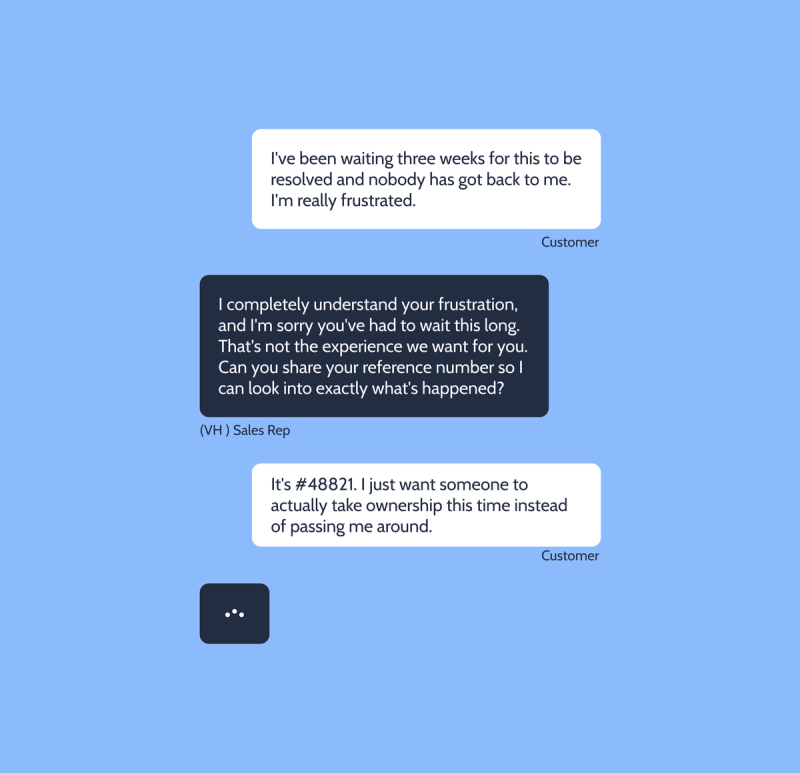
AI roleplay removes the audience barrier. With Virti, you can practise the conversational aspects of public speaking, handling audience questions, responding to challenges, explaining an idea to someone who pushes back, against an AI character that responds dynamically to what you actually say.
Virti also supports branching scenarios for practising the decision moments within a presentation: how to respond when someone interrupts, whether to acknowledge a challenging question immediately or return to it at the end, how to adapt when the technology fails. These structured scenarios let you explore the consequences of different choices in a safe environment before they happen live.
Practice is available on demand: before an important presentation, during a lunch break, or at 10pm the night before. There is no scheduling and no audience required. After every session, your feedback shows exactly what you said against each point you are assessed on, and Virti AI Coaching remembers every session, so it can tell you whether the habit you worked on last time is improving.
How to Build a Public Speaking Practice Habit
The single biggest difference between people who improve at public speaking and people who do not is not talent. It is how often they practise. Here is how to build a practice habit that compounds over time.
Start with five minutes, not fifty
The barrier to practice is almost always getting started. Five minutes of spoken practice is worth more than an hour of mental rehearsal. Make it easy to begin by keeping the commitment small, one explanation, one difficult question, one opening, and build from there.
Practise the hard parts, not just the comfortable ones
Most people practise the sections they already know well because that is where the confidence lives. The sections that need the most work are the ones that feel most uncomfortable to practise, which is exactly why they need the most repetition.
Use feedback deliberately
After each practice session, identify one specific thing to improve in the next one. Not a general aspiration, "be more confident", but a specific behaviour: "slow down when I get to the technical explanation" or "pause before answering a question rather than rushing to fill the silence."
Increase the pressure progressively
Start with low stakes practice: alone, aloud, with no audience. Build toward practice with a colleague, then a small group, then a recorded session you have to watch back. The goal is to make the real presentation feel like a familiar level of pressure rather than an unfamiliar one.
How to Get Started
If you want to build genuine public speaking confidence, the most useful thing you can do today is practise out loud rather than in your head. Pick one scenario, the explanation you find hardest to make clear, the question you most dread being asked, and run through it until the response feels natural.
With Virti, that practice can happen against a virtual audience member who responds realistically, asks follow up questions, and provides specific feedback on what to improve. Whether you are preparing for a conference presentation, a board meeting, a job interview, or a difficult conversation in front of a group, the scenarios can be built around exactly what you are facing.

Before You Go
- Preparation gives you something to say: practice gives you the ability to say it clearly and confidently under pressure
- Effective public speaking practice is out loud, includes the unexpected, and involves specific feedback: passive rehearsal in your head does not count
- The scenarios worth practising most are: explaining a complex idea clearly, handling challenging questions, responding to interruptions, recovering when you lose your thread, opening strongly, and adapting when the audience is not engaging
- AI roleplay makes public speaking practice more accessible by removing the audience barrier: practise handling questions and challenges against a virtual character that responds dynamically to what you actually say
- The biggest difference between people who improve at public speaking and those who do not is how often they practise: start with five minutes out loud rather than waiting for the perfect conditions
- With Virti, public speaking practice scenarios can be built around exactly what you are facing and are available on demand, whenever you need them
Frequently Asked Questions
How often should I practise public speaking to see improvement?
Frequent short sessions are more effective than occasional long ones. Five to ten minutes of deliberate spoken practice several times a week will produce faster improvement than a single two hour session before an important presentation. The goal is to build a consistent habit rather than cramming: the nervous system responds to repetition over time, not intensity in a single sitting.
What is the most effective way to practise handling audience questions?
The most effective method is to practise with someone, or something, that can ask questions you have not prepared for. Ask a colleague to play devil's advocate. Use an AI roleplay tool that asks follow up questions based on what you actually say. The goal is to practise the composure and clarity of your response under genuine uncertainty, not to rehearse answers to questions you already know are coming.
Can AI roleplay really help with public speaking practice?
Yes, particularly for the conversational aspects of public speaking that are hardest to practise alone. Virti's AI powered Virtual Humans respond dynamically to what you say, ask follow up questions, and push back on points that are unclear, replicating the kind of audience interaction that makes public speaking genuinely challenging. For the structured decision moments within a presentation, branching scenarios let you practise different responses and see how they play out, building the confidence to adapt in the moment rather than being thrown by the unexpected.
How can I practise public speaking at home?
Stand up and speak aloud rather than reading through your notes. Record yourself on your phone and watch it back for pace, filler words and body language. Then add the unexpected: ask a friend to put questions to you, or use an AI roleplay tool that responds to what you actually say, so you practise the parts of public speaking you cannot script.