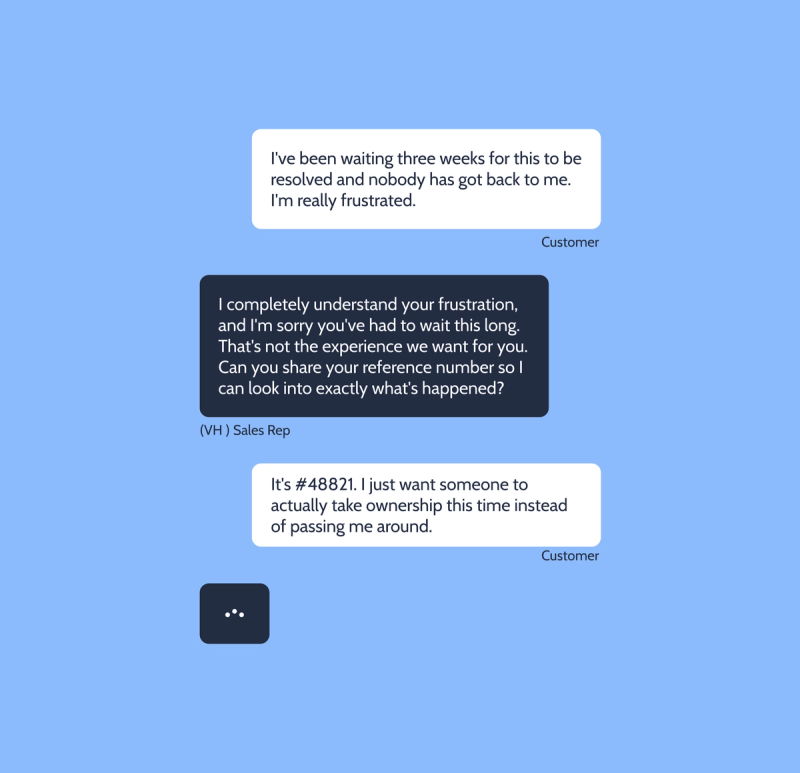
It’s a Monday morning. A rep takes their first difficult call, a customer who is angry, impatient, and not interested in being managed. The customer service representative knows the policy. They’ve read the handbook. But nothing in their training prepared them for the feeling of someone talking over them, dismissing every response, and threatening to cancel on the spot.
They fumble. The customer leaves. And the rep spends the rest of the day second-guessing every call that follows.
Every customer service manager has seen this moment. The question isn’t whether it happens, it’s whether your training is doing anything to prevent it.
Let’s uncover how customer service scenarios change that.
Your Learning Path Today
- Why the gap between knowing and doing is where most customer service teams lose customers
- What customer service training is and how it differs from traditional role play
- What good customer service scenarios look like in practice
- The skills simulation training builds fast and why they matter most under pressure
- How to get started with customer service training in your team
The Gap Between Knowing and Doing
Customer expectations have shifted significantly. Today’s customers are more informed, less patient, and faster to switch than previously. They arrive in conversations already frustrated, having tried the FAQ, the chatbot, and the help article before they ever reach a human. By the time they’re on the phone or in a chat, the bar for what a good interaction looks like is high, and the tolerance for a rep who sounds uncertain is low. This directly impacts customer satisfaction, as customers expect quick, confident, and effective resolutions to their issues.
Most customer service training prepares agents to know the right answers. Product knowledge, company policy, escalation procedures; all of it covered, tested, and signed off. But knowing the right answer and delivering it with confidence under real pressure are two completely different customer service skills.
A rep can pass every assessment and still freeze when a customer raises their voice. They can recite the refund policy word for word and still lose control of a conversation the moment it turns emotional. Knowledge lives in the head. Confidence lives in the body, and it only develops through experience.
That’s the gap. And this is where the majority of customer service training falls short.

What Is Customer Service Simulation Training?
Customer service simulation training is the practice of placing agents in realistic, AI-powered customer interactions before they face real customers. Rather than reading about how to handle a difficult customer, reps actually handle one in a safe environment where mistakes are learning moments, not lost accounts.
Unlike scripted role plays or face-to-face exercises, customer service scenarios use AI to create conversations that respond and adapt in real time. The virtual customer reacts to what the rep says, how they say it, and adjusts their behaviour accordingly, just as a real customer would. That means no two simulations play out exactly the same way, and reps have to think on their feet rather than follow a script.
The result is practice that builds the kind of confidence that classroom training never can, because it comes from experience, not instruction.
Did you know? Engaging in active, hands-on practice increases knowledge retention by up to 90% compared to traditional classroom learning.
What Great Customer Service Scenarios Look Like
Not all training simulations are created equal. The ones that actually build confident teams share a few characteristics.
- They reflect real interactions: The scenarios are built around the conversations your agents actually have; the frustrated customer explaining a delayed payment plan, the caller who wants a refund outside of policy, the complaint that starts calmly and escalates quickly. When reps recognise the situation, the practice lands harder.
- They create genuine emotional pressure: A scenario that feels too easy teaches nothing. Realistic scenarios are designed to make reps uncomfortable, to replicate the emotional weight of a difficult interaction so that when the real thing happens, it already feels familiar.
- They cover a range of customer types: Confidence comes from variety. Reps need to practise against customers who are angry, passive-aggressive, confused, and unreasonable. The wider the range of scenarios, the more prepared they are for whatever comes next.
- They close with meaningful feedback: The scenario itself is only half the value. What happens after matters just as much. Effective simulation training provides specific, actionable feedback on what the agent did well, where they lost control of the conversation, and exactly what to try differently next time.
Key Skills Simulation Training Builds Fast
Some skills develop naturally over time. Others only develop if you deliberately practise them and they’re exactly the skills that determine whether a customer stays or leaves.
De-escalation. The ability to bring a heated interaction back to a productive place is one of the hardest skills in customer service, particularly in call centres. It requires tone control, active listening, and the confidence to stay calm when a customer isn’t. Simulating this scenario gives agents the repetitions they need to make de-escalation instinctive.
Empathy under pressure. It’s easy to be empathetic with a polite customer. It’s much harder when you’re being talked over or blamed for something outside your control. Simulation scenarios place reps in exactly those moments, building the muscle memory to respond with empathy even when the interaction is difficult.
Handling the unexpected. Real customer interactions rarely follow a predictable path, which is why traditional training methods of scripted roleplay suck. AI-powered simulation scenarios introduce the kind of twists and turns that catch agents off guard, training them to adapt in the moment rather than rely on a script.
How to Get Started With Customer Service Simulation Training
You don’t need to replace your entire training programme to see results. The most effective approach is to identify the scenarios your team finds hardest or the real-world customer interactions your team faces daily, and start there.
Pro tip: Using real call transcriptions to build simulations enhances their authenticity, allowing agents to learn from genuine customer concerns and language patterns.
With Virti’s custom scenario builder, you can build a small set of scenarios around those specific scenarios. Run them with a pilot group, gather feedback from reps and managers, and use the data to refine before rolling out to evryone. Starting focused means starting with impact.
A customer service agent at Virti can help with this.

From there, Virti’s AI-powered virtual humans take over, responding to each rep, adapting to the conversation’s development, and delivering specific, actionable feedback at the end of every session, with no real-world consequences. No trainer time required. No scheduling. No waiting for the next workshop.
As your library of scenarios grows, Virti’s analytics give you a clear picture of where your team is improving, where gaps persist, and which reps need additional support. It’s the kind of visibility that turns customer service simulation training from a one-off exercise into a continuous performance engine.
Before You Go, Remember
- The gap between knowing the right answer and delivering it under pressure is where most customer service teams lose phone calls and where simulation training makes the biggest difference
- Customer service simulation training uses AI-powered virtual humans to create real world conversations that build genuine confidence before reps face real customers
- The best simulation scenarios reflect real interactions, create emotional pressure, cover a range of customer types, and close with specific, actionable instant feedback
- The soft skills that matter most, problem solving, empathy under pressure, quality assurance, only develop through repeated, realistic practice
- With Virti, you can build and deploy scalable training from your existing training materials, with analytics that show exactly where your team is improving
Frequently Asked Questions
- Why is role-playing effective in customer service training?
Role-playing scenarios in customer service training allow agents to practice handling real-life situations without the risk of negatively impacting actual customers, thereby enhancing their confidence and performance. - How effective are simulation tools for knowledge retention?
Hands-on practice through simulation tools can improve knowledge retention rates by up to 75%, making them more effective than traditional training methods. - How do you measure the ROI of simulation tools?
Measuring the return on investment (ROI) of simulation tools involves tracking metrics such as reduced onboarding costs, improved agent performance, and lower turnover rates, which can demonstrate the financial impact of effective training.