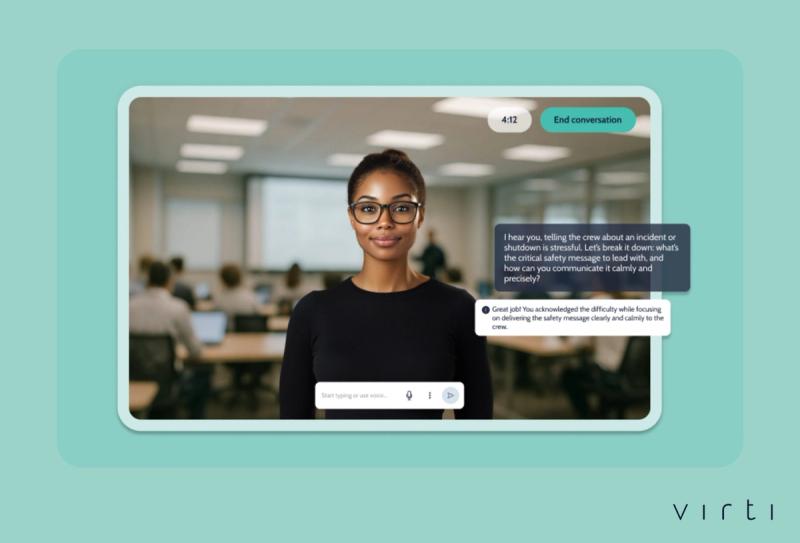
A rep finishes a practice call. The AI buyer was polite, accepted every answer, and the feedback said "Great job, try to sound more confident." Nothing was learned.
That is what happens when AI sales role play scenarios are built around a script instead of a skill. The buyer feels generic, the feedback feels vague, and reps quickly stop practising.
Built well, the same scenario becomes the most useful ten minutes of a rep's week. The buyer pushes back like a real customer, the feedback points to the exact moment the conversation turned, and the rep knows precisely what to try next time. This guide shows you how to build that.
Your Learning Path
What Makes an AI Sales Role Play Scenario Work
An AI sales role play scenario is a practice conversation between a sales rep and an AI buyer or Virtual Human, built around a specific sales moment, with feedback that scores what the rep actually did. On Virti, that buyer is a Virtual Human: it listens, responds in real time, raises objections, and shifts its mood depending on how the conversation goes.
The scenarios that change behaviour share three things:
- Focus: one sales moment and one skill per scenario, not a whole sales cycle in ten minutes.
- Realism: a buyer with a believable role, priorities and objections, who rewards good questions and resists a premature pitch.
- Useful feedback: coaching tied to observable behaviours, with evidence from the conversation and one clear next step.
Miss any one of these and practice becomes a box to tick. Get all three right and reps come back on their own. In one global sales pilot on Virti, reps completed an average of 32.5 voluntary practice sessions each.
Step 1: Choose One Sales Moment and One Skill
Start with the performance gap, not the prompt. Ask where deals are stalling and which conversations your managers spend the most time coaching. The answer is usually one of a handful of sales moments:
- Discovery calls that never reach business impact
- Objection handling on price, timing or risk
- Negotiations where reps discount too early
- Executive conversations that need a sharper value story
- Renewal calls with a quietly unhappy customer
Pick one moment per scenario. A discovery scenario should not also test pricing, negotiation and renewal strategy. Narrow scenarios produce clearer practice and far more specific feedback.
Then define the learner. A new business development rep qualifying an inbound lead needs a different scenario from an experienced account executive defending value in a procurement negotiation. Write down their role, experience level and what success looks like, for example: "asks at least three discovery questions about business impact, summarises the buyer's needs, and secures a next meeting."
That success statement becomes the backbone of your feedback later, so make it observable. "Sounds confident" can't be scored. "Confirms the decision process before proposing next steps" can.

Step 2: Build a Buyer Worth Practising With
Most sales role play scenarios feel artificial because the buyer is too easy to please. A realistic AI buyer needs a full brief, just as an actor would.
Give the buyer a complete profile
- Job title, company size, industry and level of influence
- Business priorities, personal goals and buying criteria
- Personality and communication style, from rushed and blunt to cautious and detailed
- Current situation, pain points and stage in the buying process
- Likely objections around price, risk, timing or implementation
Base the profile on real evidence: call recordings, win and loss reviews, and the objections your reps hear every week. The closer the buyer is to your actual customers, the more the practice carries over to real calls.

Let the conversation flex
Avoid rigid branching where every answer leads to one fixed response. Instead, give the buyer conversation rules. For example, the buyer only reveals budget concerns once the rep asks about business impact. If the rep jumps straight into a product pitch, the buyer becomes guarded. If the rep asks thoughtful questions, the buyer opens up.
This is what makes a Virtual Human feel real. It rewards good selling and resists poor selling, exactly as a customer would.
Set clear boundaries
Tell the buyer what it knows and what it doesn't. Upload approved product information, pricing rules and proof points so the conversation stays accurate. If a rep asks something the buyer wouldn't know, it should say so rather than invent an answer. For regulated teams, this is also where approved claims and compliance language live.
Add stakeholders when reps are ready
Once reps are comfortable one to one, raise the difficulty. A finance lead who questions return on investment, or a technical evaluator who challenges implementation, turns a simple call into a realistic multi stakeholder deal.
Step 3: Design Feedback Reps Can Act On
Feedback is where most AI role play falls down. A single overall score tells a rep how they did, not what to change. Realistic coaching feedback is specific, grounded in evidence from the conversation, and tied to behaviours the rep can repeat.
Build a rubric around observable behaviours
Score each behaviour separately, for example on a scale of one to five:
- Asked relevant discovery questions
- Uncovered the business impact of the problem
- Connected the solution to the buyer's priorities
- Handled objections accurately and calmly
- Avoided unsupported claims
- Agreed clear next steps
Add examples of strong and weak responses for each behaviour so feedback stays consistent from one rep to the next.
Use a simple feedback structure
Good coaching feedback follows the same pattern every time: one strength, one priority improvement, example language, and a next practice action. For example:
- Strength: You built trust by reflecting the buyer's concern back to them.
- Improvement: You moved to the product before confirming the business impact.
- Try saying: "What does that delay cost your team each month?"
- Next attempt: Ask one impact question before presenting a solution.
Keep it to one or two priorities. Reps act on focused feedback and skim long lists.
Make feedback build over time
With Virti AI Coaching, feedback doesn't start from zero each time. The coach remembers every session, so it can spot patterns, such as a rep who consistently skips impact questions, and adjust its coaching as the rep improves.
Feedback should also match experience. New reps need coaching on discovery, listening and next steps. Experienced sellers get more from feedback on deal control, executive communication and message precision.
AI coaching works best alongside managers, not instead of them. AI handles the volume, with immediate, consistent feedback after every attempt. Managers focus on judgement, deal strategy and motivation, using the practice data to coach where it matters most.

Step 4: Pilot, Measure and Scale
Before rolling scenarios out across the sales team, run a small pilot with a handful of reps at different levels and two or three experienced managers. Ask them to check each scenario for:
- Realism: does the buyer sound and behave like a real customer?
- Accuracy: are product claims, pricing and policies correct?
- Difficulty: is it challenging without being impossible?
- Feedback quality: does the coaching explain what happened and how to improve?
Compare the AI feedback with what your managers would have said. Where they agree, you have a rubric you can trust. Where they don't, refine the scoring before you scale.
Then measure what matters. Track practice frequency, scores across repeated attempts and the most commonly missed behaviours. Over time, connect that data to sales outcomes such as conversion rates, deal velocity and win rates, so you can see whether better practice is producing better results.
To scale across regions, keep the core skill the same and adapt the context: language, buyer expectations, regulations and terminology. A discovery scenario for a healthcare buyer in Germany and a retail buyer in the United States can test the same behaviours through very different conversations.
How to Get Started
You don't need a full scenario library on day one. Start with the one sales conversation your reps find hardest, whether that is a price objection, a discovery call that never reaches business impact, or a negotiation that ends in discounting.
Build two or three focused AI sales role play scenarios around it, run them with a small pilot group, and use the feedback data to see where confidence is growing and where gaps remain. Then move on to the next sales moment.
With Virti, you can build Virtual Human buyers from your existing sales materials, set your own rubric, and have reps practising within hours rather than weeks.

Before You Go Remember
- Build each AI sales role play scenario around one sales moment, one learner and one observable skill
- Give the AI buyer a full profile, flexible conversation rules and clear boundaries so it behaves like a real customer
- Score observable behaviours, not personality, and give reps one strength, one priority and one next step
- Use AI coaching for volume and consistency, and managers for judgement and deal strategy
- Pilot with a small group, compare AI and manager feedback, then scale with local context
Frequently Asked Questions
What are AI sales role play scenarios?
AI sales role play scenarios are practice conversations where sales reps talk to an AI buyer that responds in real time, raises objections and reacts to how the rep sells. Each scenario focuses on a specific sales moment, such as a discovery call or a price negotiation, and ends with coaching feedback on what the rep did well and what to try next.
How realistic can an AI sales role play be?
Very realistic, when the scenario is designed well. A buyer with a clear role, priorities, personality and objections, plus rules about when to open up or push back, behaves much like a real customer. Realism comes from the quality of the scenario brief, not from making the buyer difficult for the sake of it.
How does AI give fair coaching feedback to sales reps?
By scoring every rep against the same rubric of observable behaviours, such as discovery questions, objection handling and next steps, and backing each point with evidence from the conversation. That consistency is hard to achieve with live role play, where feedback varies from manager to manager.
Does AI role play replace sales managers?
No. AI role play gives reps unlimited, immediate practice and feedback, which frees managers from running repetitive role plays. Managers then use the practice data to focus their coaching on judgement, deal strategy and the reps who need it most.
How do you measure whether AI sales practice is working?
Start with baseline scores for the behaviours you are training, then track how they change across repeated attempts. Compare those trends with manager observations and sales metrics such as conversion rates, deal velocity and win rates. Look at trends across teams rather than any single score.