how can i measure whether an ai-driven training simulation is improving performance for a distributed workforce across
In 2026, measure an AI-driven training simulation by comparing a documented baseline with changes in demonstrated skills, workplace behavior, and business outcomes. Use the Kirkpatrick model, segmented reporting, control groups where practical, and data integration across learning, operational, and employee systems.
The strongest evidence comes from measuring training effectiveness over time—not from completion rates alone. Track whether AI-powered training produces real-time feedback, improved capability, behavior transfer, and measurable business value across regions and roles.
Table of Contents
- how can i measure whether an ai-driven training simulation is improving performance for a distributed workforce across global teams?
- Which metrics show whether AI-powered simulation training is working?
- how can i measure whether an ai-driven training simulation is improving performance for a distributed workforce across different regions and roles?
- Apply the Kirkpatrick model to AI-driven immersive learning
- how can i measure whether an ai-driven training simulation is improving performance for a distributed workforce across different training formats?
- Turn simulation analytics into continuous performance improvement
- Frequently asked questions about measuring AI-driven training simulation impact
how can i measure whether an ai-driven training simulation is improving performance for a distributed workforce across global teams?
Training effectiveness is the measurable change in employee capability, behavior, and business performance after learning.
To answer how can i measure whether an ai-driven training simulation is improving performance for a distributed workforce across, start before launching the program. Define four essentials:
- The performance problem: What needs to improve, such as sales conversion, customer resolution, or clinical accuracy?
- The target skills: Which behaviors should employees demonstrate?
- The learner population: Which roles, regions, languages, and experience levels are included?
- The business outcome: What result should change, and by how much?
This baseline gives your training program something stronger than a completion target. It creates a clear comparison between current performance and future performance.
Measuring training effectiveness requires a data-driven measurement plan that connects employee training with operational priorities. In 2026, define the baseline before implementing AI so leaders can identify whether an improvement came from the learning experience, a process change, or normal business variation.
Build a balanced measurement framework
A reliable evaluation combines several types of data:
- Learning data: Scenario scores, skill ratings, retries, time to proficiency, and knowledge checks.
- Behavioral evidence: Manager observations, work samples, quality reviews, and real-world behavior changes.
- Employee feedback: Confidence, relevance, realism, and perceived readiness after each practice session.
- Operational metrics: Sales results, customer satisfaction, handling time, error rates, compliance findings, or productivity.
Completion rates show activity. They do not prove capability. As Skillwell explains, effective measurement treats data as evidence of capability rather than activity. (How Companies Measure AI Training Effectiveness)
Compare results across locations, teams, and time periods. Use a baseline group where practical. Also check whether improvements last after training ends. This helps separate genuine performance gains from short-term test familiarity.
Key insight: A credible evaluation connects practice behavior to workplace behavior, then connects workplace behavior to a business outcome.
How Virti supports the learning loop
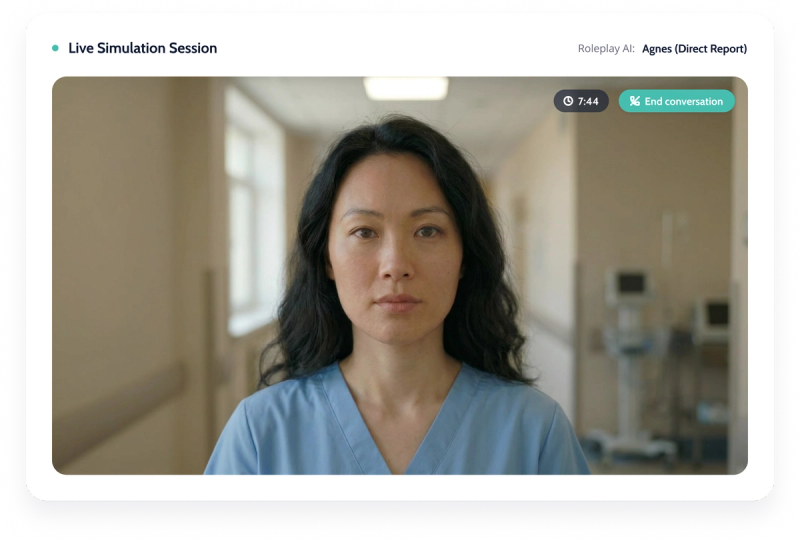
Virti connects immersive practice, AI Virtual Humans, and analytics in one repeatable workflow. L&D teams can create realistic scenarios without specialist development resources. Employees then practice difficult conversations, sales pitches, leadership moments, or service interactions.
AI Virtual Humans can respond dynamically, while interactive video and role-play capture how an employee performs. These tools reflect broader AI training and development use cases. Analytics can reveal common skill gaps, regional patterns, and improvement over repeated attempts. Teams can then refine the scenario, provide targeted coaching, and measure again.
This approach supports global workforce development across mobile, desktop, and VR. It also helps connect learning data with workplace evidence, rather than keeping training in a separate reporting silo. Research shows that combining simulation data with work samples, manager observations, and quality scores offers stronger evidence of transfer. (Source: AI in L&D: Training Completed, But Did It Work?)
Measure AI training by tracking whether practice changes workplace behavior and business results—not simply whether employees completed the training.
Which metrics show whether AI-powered simulation training is working?
AI-powered simulation training is working when learners demonstrate stronger skills, transfer those skills to work, and contribute to better operational outcomes.
To answer how can i measure whether an ai-driven training simulation is improving performance for a distributed workforce across locations and roles, use both leading and lagging indicators.
Leading indicators show whether employees are practicing and improving. Lagging indicators show whether training changes workplace performance. Neither tells the whole story alone.
Leading indicators: early signals of progress
Participation, completion, and repeat practice reveal whether employees are actively using simulation training across locations, devices, and time zones.
Confidence scores, engagement ratings, and voluntary retries indicate whether learners feel safe enough to practice difficult conversations repeatedly.
Time to proficiency measures how quickly each employee reaches a defined performance standard, rather than simply finishing assigned learning.
Simulation data can flag unusual behavior, such as implausibly fast completions, inconsistent scoring, or repeated attempts without improvement.
Track these measures by team, region, role, language, and experience level. Distributed workforce data can reveal access problems that an overall average hides. For example, one group may complete training quickly, while another struggles with connectivity or scheduling.
Skill and behavior measures
Skill accuracy, response quality, and conversation behaviors show whether employees apply the expected knowledge during realistic workplace scenarios.
Knowledge retention improves when employees demonstrate correct decisions days or weeks after training, not only immediately after completion.
Feedback trends from every simulation reveal recurring skill gaps, coaching needs, and scenario areas that require content updates.
A strong simulation measures more than correct answers. It can assess listening, empathy, question quality, objection handling, policy adherence, and escalation choices. These signals are often more useful than recall-based quizzes because employees must perform realistic tasks.
Virti supports this learning loop through AI Virtual Humans, interactive video, and analytics. Teams can create no-code scenarios, review performance data, and scale practice across mobile, desktop, or VR.
Lagging indicators: business impact
Connect training analytics with sales conversion, customer satisfaction, service quality, compliance, safety, or productivity metrics.
Compare trained and untrained groups, or baseline and post-training results, while controlling for role, market, tenure, and workload differences.
A large enterprise reported 21% higher skill performance, 97% fewer simulated errors, and 15-times faster deployment after adopting AI simulations. (Source: How AI-Powered Simulation Training Is Redefining Workforce Readiness)
Business outcomes take longer to appear, but they provide the strongest evidence for executives. Combine operational data with manager observations, work samples, quality scores, and system activity.
The best answer to how can i measure whether an ai-driven training simulation is improving performance for a distributed workforce across regions is to connect practice data with real-world results.
Measure practice, skill growth, and business outcomes together to see whether training changes performance—not just completion rates.
how can i measure whether an ai-driven training simulation is improving performance for a distributed workforce across different regions and roles?
A fair global evaluation compares improvement against a shared baseline while accounting for regional, role-based, language, and access differences.
A simulation can show high completion rates without proving better workplace performance. Distributed teams also face different customer expectations, languages, regulations, devices, and working conditions. Without a shared baseline, comparisons become unreliable. A sales employee in London may face different demands than a support employee in Singapore. Comparing raw scores alone can create more confusion than insight.
To answer how can i measure whether an ai-driven training simulation is improving performance for a distributed workforce across, compare each employee’s pre-training results with later simulation and workplace outcomes. Track skill improvement, not attendance. Use a consistent scoring model, then segment the data by region, role, tenure, language, team, and access method. Protect privacy by reporting group trends only when cohorts are large enough.
1. Establish a reliable baseline
Capture performance before training begins. Use one or more of these methods:
- A scored simulation or recorded role-play
- Knowledge and judgment assessments
- Manager ratings using a shared rubric
- Quality assurance scores, customer feedback, or sales conversion data
- Operational measures, such as handling time, error rates, or escalation rates
The baseline should reflect the behavior the training aims to improve. For example, a customer service program might assess empathy, accuracy, policy adherence, and resolution quality. Virti can use AI Virtual Humans, video, and interactive scenarios to create repeatable practice before and after training.
A baseline is a documented measure of current capability before learning begins. Without one, teams cannot separate training impact from normal performance changes.
Use a pilot before a global rollout. A pilot can identify scoring bias, technology barriers, and unclear objectives before employee training programs expand across countries. In 2026, a small pilot also gives leaders a practical opportunity to validate AI integration and data integration with systems such as Workday, Cornerstone, SAP SuccessFactors, Salesforce, or an LMS.
2. Compare fairly across regions and roles
Use the same core scenario, instructions, and scoring standards for every cohort. This creates a fair comparison across remote, hybrid, and office-based employees. Keep local adaptations where laws, products, customer expectations, or cultural norms differ.
For example, the communication standard may remain consistent, while examples and compliance steps change by country. Record these adaptations in the evaluation plan. This helps leaders understand whether score differences reflect skill gaps or local requirements.
Analyze both individual and cohort progress. Useful measures include:
- Pre- to post-training score improvement
- Time taken to reach proficiency
- Number of practice attempts
- Feedback themes and recurring errors
- Transfer to job metrics after 30, 60, or 90 days
Segmented reporting can identify employee disengagement, unequal access, and retention risks. A language group may need clearer prompts, while a new-employee cohort may need more practice. Limit access to employee-level data, remove unnecessary identifiers, and follow applicable privacy rules.
Research supports this approach. Skill improvement between pre- and post-training performance is a strong effectiveness signal. AI training data becomes more useful when combined with manager observations, simulations, work samples, and operational metrics.
Measure progress against a shared baseline, then use segmented data to target coaching without compromising employee privacy.
Apply the Kirkpatrick model to AI-driven immersive learning
The Kirkpatrick model measures learning through reaction, learning, behavior, and results, giving organizations a structured way to evaluate AI-driven immersive learning.
TL;DR: To answer “how can i measure whether an ai-driven training simulation is improving performance for a distributed workforce across” regions and roles, track four connected levels: reaction, learning, behavior, and business results. AI simulation data can show what employees practice, improve, and apply at work.
The kirkpatrick model is useful because it prevents teams from treating learner satisfaction as proof of business value. The kirkpatrick model also helps connect AI-powered training to employee development, operational efficiency, and improved retention rates.
Levels 1 and 2: Measure the practice experience
The Kirkpatrick Model evaluates training across four levels: Reaction, Learning, Behavior, and Results. This structure helps connect learner feedback with skill development and business performance. (Source: The Kirkpatrick Model: 4 Levels, Examples, and Free Template)
Level 1 measures how employees respond to the training experience. Ask whether the scenario felt relevant, realistic, engaging, and useful. Measure confidence before and after practice. Short surveys, rating prompts, and AI-assisted sentiment analysis can reveal where learners lose interest or need more support.
For a distributed workforce, compare reactions by region, role, language, device, and delivery method. A sales employee using a laptop may respond differently from a field worker using mobile or VR. These comparisons can expose access issues that may otherwise look like weak learning.
Level 2 measures what employees know and can demonstrate inside the simulation. Go beyond course completion. Track decisions, communication quality, listening, empathy, product knowledge, policy compliance, and correct use of escalation steps.
Use scenario scores, retry patterns, response quality, and time to resolution as learning data. Pre-tests and post-tests can also show improvement more clearly. (Source: The Kirkpatrick Training Evaluation Model)
An AI Virtual Human can assess the same skill across repeated practice sessions. This creates a consistent baseline for employees in different locations. It also gives managers evidence of progress without relying only on self-reported confidence.
Levels 3 and 4: Connect simulation results to work
Level 3 measures whether employees transfer simulated behaviors into real work situations. Look for changes in customer conversations, sales calls, leadership interactions, or compliance decisions. For example, a customer service employee may use better questioning techniques after practicing with an AI role-play.
Connect training records with manager observations, quality reviews, call monitoring, CRM data, or compliance audits. Compare results before and after training, while controlling for major changes such as new products or staffing shifts. This helps distinguish real behavior change from simple correlation.
Level 4 measures whether behavior change improves business outcomes. Depending on the program, track productivity, revenue, customer retention, quality scores, employee retention, complaint rates, or risk reduction.
For example, sales training may connect stronger discovery skills with conversion rates. Leadership training may link better feedback conversations with employee retention. Compliance training may connect improved decisions with fewer incidents. The right outcome depends on the business problem, not the platform.
To answer “how can i measure whether an ai-driven training simulation is improving performance for a distributed workforce across” global teams, use shared definitions and local benchmarks. A platform should let you segment data by region and role while protecting employee privacy.
Virti supports this evaluation loop through no-code scenario creation, repeatable AI role-play, immersive video, and analytics across desktop, mobile, and VR. Buyers should also assess LMS integration, governance, reporting depth, and whether the data supports business decisions.
A 2026 measurement plan should include a counterfactual wherever possible: what would likely have happened without the intervention? Use a matched comparison group, staggered rollout, or interrupted time-series analysis. This makes the analysis more credible than a simple before-and-after comparison.
Expert measurement principle: The kirkpatrick model is strongest when Level 4 business indicators are linked to observable Level 3 behavior rather than reported as an isolated training result.
The strongest measurement approach links learner reaction, demonstrated skill, workplace behavior, and business performance in one continuous training data loop.
how can i measure whether an ai-driven training simulation is improving performance for a distributed workforce across different training formats?
Compare training formats by the quality, consistency, accessibility, and workplace relevance of the evidence each format produces.
What should you compare?
The best format depends on the evidence you need. Compare each option against six measures: realism, repeatability, scalability, feedback quality, accessibility, and behavior transfer.
| Training format | Strengths | Measurement limits |
|---|---|---|
| AI role-play | Realistic conversations, repeatable practice, instant feedback, detailed performance data | Requires well-designed scoring rubrics and quality controls |
| Immersive video | Strong emotional context, branching decisions, consistent delivery | Usually measures choices better than natural conversation |
| Live coaching | Rich feedback, personal guidance, high realism | Expensive, difficult to schedule, and less consistent across coaches |
| E-learning | Highly scalable, accessible, and easy to track | Often shows knowledge recall, not real-world behavior |
| Traditional assessments | Simple benchmarks for knowledge and compliance | May not reveal whether an employee can perform under pressure |
Behavior transfer means using new skills successfully during real work, not simply completing training.
Why does format affect the evidence?
AI Virtual Humans and interactive video allow every employee to practice the same scenario multiple times. They can also create data from each attempt, including response quality, missed steps, confidence, and improvement over time.
That consistency is difficult to achieve with occasional live workshops. A workshop may provide excellent feedback, but each employee receives different practice time, coaching, and scenarios. AI-driven role-play can provide comparable practice data across regions, roles, and time zones.
Research supports measuring demonstrated capability rather than attendance. Skill improvement between pre- and post-training assessments remains one of the clearest effectiveness signals.
Use several evidence types together:
- Simulation scores and rubric results
- Repeat-attempt improvement
- Manager observations
- Work samples and quality scores
- Customer outcomes, sales conversion, or resolution time
- Follow-up assessments after 30, 60, and 90 days
This approach answers how can i measure whether an ai-driven training simulation is improving performance for a distributed workforce across different learning formats? It connects learning data with workplace performance, rather than treating completion as success. Standards such as xAPI can help combine these records across digital courses, simulations, and workplace activity.
Modern employee training programs should pair adaptive learning with consistent evaluation. Adaptive learning can change prompts or difficulty, but the final assessment should preserve comparable scoring criteria. This balance helps teams adapt practice without weakening measurement validity.
How should you run a fair pilot?
Start with one role and one measurable behavior. For example, test whether customer service employees improve empathy and first-contact resolution.
- Assess 50 employees before training.
- Give 25 employees AI role-play or interactive video practice.
- Give 25 employees existing training, creating a control group.
- Repeat the same assessment after two weeks.
- Compare scores, behavior transfer, and business results after 30 days.
Virti supports mobile, desktop, and VR delivery, with enterprise LMS integrations. This helps a global workforce access the same training while leaders review comparable data. Its no-code authoring also supports faster scenario updates as policies change.
One enterprise study reported a 21% increase in skill performance, a 97% reduction in simulated errors, and 15x faster deployment with AI-powered simulations.
Choose the format that produces repeatable practice data and proves better performance on the job.
Turn simulation analytics into continuous performance improvement
Continuous performance improvement is the process of using training data, feedback, and business results to improve employee performance over time.
Once measurement begins, ask: how can i measure whether an ai-driven training simulation is improving performance for a distributed workforce across regions, roles, and experience levels? The answer is not one score. Look for patterns that show where employees struggle and which practice changes behavior.
In the 2026 landscape, artificial intelligence and machine learning can help identify patterns across large learning populations. However, artificial intelligence should support human judgment rather than replace governance, instructional design, or manager coaching.
Find the gaps behind the numbers
Review simulation analytics on a regular schedule. Look for:
- Recurring errors in decisions, language, or process steps
- Hesitation points that slow customer or operational responses
- Missed learning objectives across teams or regions
- Coaching themes that appear in feedback repeatedly
- Anomalies, such as unusually fast completions or inconsistent scoring
These patterns can reveal a content gap, a capability gap, or both. For example, repeated errors may signal unclear training content. Long pauses may show that employees need more practice with a complex scenario.
AI can help identify these trends faster than manual review. Learning analytics can also flag data quality issues before they distort reports.
Use predictive indicators carefully. A predictive model may identify cohorts at risk of employee disengagement or lower retention rates, but leaders should validate the signal before assigning additional learning or intervention.
Personalize the next practice step
Use AI-generated insights to recommend targeted scenarios for each employee. Someone who struggles with objection handling may need a sales role-play. Another employee may need practice with escalation, empathy, or compliance language.
Create learning paths that respond to demonstrated performance, not just job title. Let employees repeat realistic scenarios until their decisions become more consistent. This supports continuous coaching throughout the employee lifecycle. (Source: What Is AI Simulation Development? The Missing Link Between Training and Performance)
Virti helps teams deliver this practice through AI Virtual Humans, interactive video, and analytics. Employees can practice on mobile, desktop, or VR. Distributed workforce training can therefore remain consistent while still adapting to individual needs.
This ai-driven learning approach can improve employee development when recommendations are transparent and actionable. It can also support ai-powered training engaging experiences by giving learners immediate, relevant practice instead of repeating content they have already mastered.
Connect learning data to business priorities
Schedule regular reviews with L&D, HR, sales, customer service, compliance, and operational leaders. Compare training data with business measures, such as conversion rates, quality scores, customer feedback, safety events, or resolution times.
Then use Virti’s no-code authoring and analyze-and-improve workflow to scale high-performing scenarios. Revise or retire low-impact experiences. This creates a practical cycle: create, learn, analyze, and improve.
The goal is not merely efficiency in content delivery. It is operational efficiency through better decisions, stronger service, improved retention, and reduced avoidable errors. Teams should identify which training programs are driving real impact and which need redesign.
The best AI simulation programs use performance data to personalize practice, improve content, and connect learning with business results.
Frequently asked questions about measuring AI-driven training simulation impact
AI-driven training simulation impact is best measured through a combination of learner evidence, behavior transfer, and business outcomes tracked over time.
How long does it take to see performance improvements from an AI-driven training simulation?
Most organizations see early capability changes within weeks, while measurable business impact often takes several months. The timeline depends on the skill, practice frequency, baseline performance, and quality of follow-up data. Track leading indicators first, such as fewer errors, stronger decisions, and shorter time to proficiency. Then connect these changes to business outcomes, including sales conversion, customer satisfaction, productivity, or safety results. Compare pre-training and post-training assessments to identify progress.
What is the difference between training engagement and business impact?
Training engagement shows whether employees participated, while business impact shows whether performance improved. Completion rates, time spent, and learner ratings can reveal whether training is accessible and relevant. However, these measures do not prove capability. Stronger evidence includes improved assessment scores, reduced errors, faster task completion, and better customer outcomes. Use engagement data to diagnose the learning experience, not to claim return on investment. Treat data as evidence of capability, not activity.
Can simulation analytics measure soft skills such as empathy, listening, and communication?
Yes, simulation analytics can assess soft skills when scenarios use clear, observable behavior criteria. A simulation can evaluate whether an employee asks relevant questions, acknowledges concerns, avoids interruptions, and explains information clearly. AI Virtual Humans can provide consistent feedback across repeated practice sessions. Human reviewers should still validate scoring models, especially for sensitive roles or complex conversations. Combine automated feedback with manager observation, self-reflection, and real-world performance data. This creates a more balanced view of communication and interpersonal skills.
How can organizations compare results fairly across remote employees, regions, and job roles?
Organizations should compare normalized outcomes against shared standards, while accounting for role, language, access, and local context. Use the same core competencies and scoring rules across the workforce. Then review results by region, role, tenure, device, and language. Check whether scenario difficulty or technology access affects scores. Avoid ranking employees using one raw score. Instead, compare improvement from each employee’s baseline and report confidence ranges where possible. This approach helps answer how can i measure whether an ai-driven training simulation is improving performance for a distributed workforce across varied conditions.
How do AI Virtual Humans provide feedback without replacing human coaching?
AI Virtual Humans provide immediate practice feedback, while human coaches provide judgment, context, and support. Employees can rehearse difficult conversations safely and repeat scenarios without scheduling a live facilitator. The system can flag missed questions, unclear explanations, or weak listening behaviors. Managers can then focus coaching time on patterns that need deeper discussion. This blended model makes learning more frequent, not less human. It also helps coaches use performance data to personalize development plans.
What data privacy and governance considerations apply to AI-based assessments?
Organizations should collect only necessary data, explain how assessments work, and control who can access results. Establish clear retention periods, consent practices, and employee rights before launch. Separate learning feedback from disciplinary decisions unless governance teams approve that use. Review AI scoring for bias across languages, regions, and accessibility needs. Protect recordings, transcripts, and performance data through appropriate security controls. Virti supports enterprise-grade security and privacy-conscious AI usage, but each organization remains responsible for its policies and legal requirements.
How can Virti help organizations measure and scale immersive training?
Virti helps organizations create, deliver, analyze, and scale AI-powered training across distributed teams. Its no-code tools support realistic scenarios for sales, customer service, leadership, healthcare, and compliance. Scalable training is particularly important in healthcare contexts, including the global cancer workforce crisis identified by The Lancet Oncology Commission. Employees can practice with AI Virtual Humans through mobile, desktop, or VR experiences. Analytics reveal behavior patterns, capability gaps, and progress over time. LMS integrations support broader delivery and reporting. Leaders can connect simulation data with operational metrics to understand how can i measure whether an ai-driven training simulation is improving performance for a distributed workforce across global roles.
Key Takeaways
- Define a baseline before launching AI-powered training.
- Use the kirkpatrick model to measure reaction, learning, behavior, and business results.
- Combine real-time feedback with manager observations and operational evidence.
- Segment findings by region, role, language, tenure, device, and access method.
- Use a pilot or comparison group to strengthen causal analysis.
- Connect learning platforms, HR systems, CRM tools, and operational systems through data integration.
- Measure employee satisfaction, skill growth, behavior transfer, retention rates, and business outcomes together.
- Use machine learning and predictive insights carefully, with human validation and privacy controls.
- Review results regularly and adapt scenarios through continuous learning.
- The goal is driving real impact through measurable employee development and operational efficiency.
The strongest measurement approach links repeated practice and reliable simulation data to real changes in employee performance and business outcomes.