how long does it take to build and publish a new immersive training scenario using a no-code workflow
Table of Contents
- How long does it take to build and publish a new immersive training scenario using a no-code workflow?
- What happens during a no-code immersive scenario build?
- How long does it take to build and publish a new immersive training scenario using a no-code workflow in practice?
- What can speed up or slow down scenario publishing?
- No-code authoring versus custom development: which launches faster?
- How long does it take to build and publish a new immersive training scenario using a no-code workflow with enterprise review?
- Frequently Asked Questions About How Long Does It Take to Build and Publish a New Immersive Training Scenario Using a No-Code Workflow?
How long does it take to build and publish a new immersive training scenario using a no-code workflow?
A no-code immersive training workflow is a way to create, review, and publish interactive training without traditional software development.
So, how long does it take to build and publish a new immersive training scenario using a no-code workflow? For a focused enterprise scenario, a realistic timeline is three to ten business days from approved brief to published experience.
A simple scenario can move faster, as demonstrated by AI-assisted employee-training workflows that can be created in five days. A more complex learning experience may take several weeks. Traditional immersive development can take months because it often requires instructional designers, developers, and separate QA teams. (Source: Building Immersive Training Without a Development Team: The No-Code Revolution)
A realistic Virti delivery timeline
| Stage | Typical time | What happens |
|---|---|---|
| Planning | 0.5–2 days | Define the audience, learning objectives, scenario flow, and success measures. |
| Content authoring | 1–3 days | Add prompts, dialogue, video, questions, branching, and feedback. |
| AI Virtual Human setup | 0.5–2 days | Configure the Virtual Human’s role, tone, knowledge, and response boundaries. |
| Review and refinement | 1–3 days | Subject-matter experts and stakeholders review the experience. |
| Testing | 0.5–2 days | Check conversations, scoring, accessibility, devices, and learner pathways. |
| Publishing | Hours to 1 day | Apply permissions, connect the LMS if needed, and release the training. |
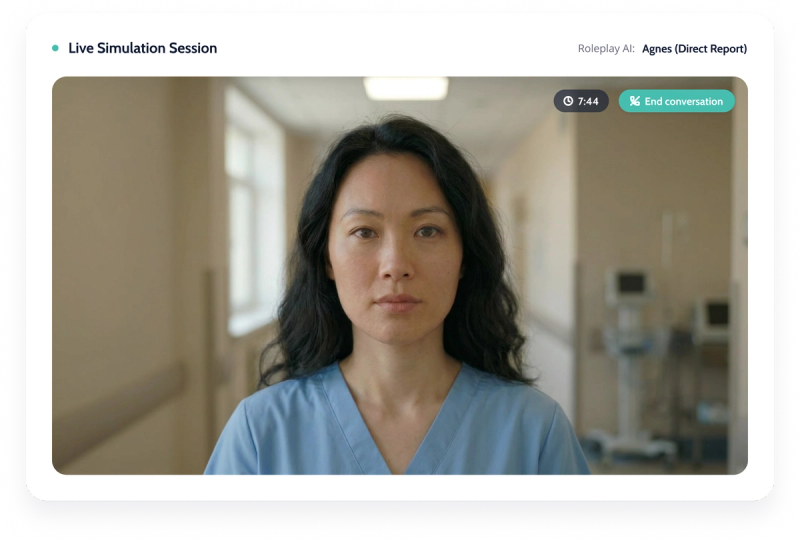
With Virti, teams can build AI-powered role-play scenarios through a no-code workflow. They can create realistic conversations for sales, customer service, leadership, compliance, and healthcare training.
The build itself is only part of the schedule. Preparing learning objectives, collecting source content, writing safe response rules, and securing subject-matter-expert feedback may take longer than the platform work.
For example, a focused customer service scenario may use an existing policy and one review cycle. A regulated healthcare scenario may require legal review, clinical approval, privacy checks, and several revisions.
What can extend the schedule?
The main factors affecting delivery speed include:
- Scenario complexity: More branches, roles, assessments, and immersive media require more design and testing.
- Stakeholder approvals: Global teams may need reviews from L&D, legal, compliance, IT, and regional leaders.
- Localization: Translation, cultural adaptation, voiceovers, and local policy checks add time.
- Integrations: LMS connections, identity management, analytics, or custom data requirements may need technical support.
- Governance: Security, privacy, accessibility, and AI usage controls can add approval steps.
- Content readiness: Missing policies, unclear objectives, or limited SME availability can delay the build.
A no-code approach removes much of the development bottleneck. It does not remove the need for sound learning design or careful review. Research on AI-assisted immersive creation also shows that early prototypes can emerge within hours, with later iterations completed quickly. (Source: AI-Powered XR Training: Build Immersive Courses by Talking to an AI Agent)
For a focused Virti scenario, expect days rather than months, provided the learning goals, content, reviewers, and approvals are ready.
What happens during a no-code immersive scenario build?
A no-code workflow turns an immersive training idea into a working learning experience without specialist developers. So, how long does it take to build and publish a new immersive training scenario using a no-code workflow? The answer depends on scope, review cycles, and content readiness.
Most teams move through five practical stages:
1. Define the outcome before you build
- Start by connecting the immersive training scenario to one business outcome, such as higher conversion, safer decisions, or better customer service.
The team identifies the learner audience, workplace context, and behavior to practice. This could include sales discovery, leadership conversations, compliance decisions, clinical communication, or service recovery.
Next, define success criteria. For example, a learner may need to ask three discovery questions, follow a safety process, or show empathy during a difficult conversation. Clear criteria make learning measurable and keep the build focused.
2. Map the scenario and learning logic
- A strong scenario flow shows what learners see, say, choose, and experience after each decision or response.
The author maps the opening situation, character prompts, learner choices, branching moments, scoring logic, and feedback. The workflow can include multiple outcomes, such as a successful resolution, a missed opportunity, or a serious risk.
This design step prevents unnecessary complexity. It also helps L&D, sales enablement, customer service, compliance, and clinical teams agree on the learning goal before authoring begins.
3. Configure immersive elements without code
- No-code authoring lets subject matter experts configure AI Virtual Humans, interactive video, prompts, scoring, and feedback without writing software.
In Virti, teams can build immersive role-play with AI Virtual Humans or create interactive video training. Authors configure the conversation, tone, evaluation criteria, and learner feedback through guided tools.
They can adjust the scenario as learning needs change. A manager might make an AI Virtual Human more challenging. A compliance team might add a new policy decision. This supports faster automation and repeatable training across teams.
Some platforms report first working scenarios within 20 minutes, although enterprise review and governance can take longer (Source: Node XR | No-Code VR & Immersive Training Platform).
4. Review, test, and publish
- Content owners can test each immersive learning path, refine feedback, and publish approved training across desktop, mobile, or VR.
Reviewers check accuracy, accessibility, tone, data handling, and scoring. Teams can test branching logic before learners see it. Virti also supports analytics, LMS integrations, and enterprise governance for wider deployment.
This approach reduces handoffs between instructional designers, developers, and QA teams. Traditional immersive projects can take months because those teams must coordinate across different technical languages.
5. Analyze learning and improve the build
- After publishing, learning teams use performance data to improve prompts, feedback, scoring, and future immersive training scenarios.
Virti connects the create, learn, analyze, and scale cycle. Teams can identify common mistakes, compare performance, and target follow-up learning. They can then update the workflow without rebuilding the entire experience.
For most business scenarios, the first build is faster when scripts, policies, and success criteria already exist. How long does it take to build and publish a new immersive training scenario using a no-code workflow? A focused prototype may take minutes, while a governed enterprise launch may take days or longer.
A no-code workflow makes immersive training faster by letting the people closest to the learning build, test, publish, and improve it directly.
How long does it take to build and publish a new immersive training scenario using a no-code workflow in practice?
Enterprise teams often assume immersive training requires developers, long production cycles, and complex migration work. Traditional projects can take months because instructional designers, subject matter experts, developers, and QA teams work across separate systems. That delay makes timely training harder, especially when policies, products, or customer needs change.
For a simple customer service, sales, leadership, or compliance scenario, a no-code workflow can produce a pilot in three to five business days. A production-ready scenario usually takes two to four weeks. A global rollout may take four to eight weeks, depending on localization, governance, analytics, and LMS requirements. That is the practical answer to how long does it take to build and publish a new immersive training scenario using a no-code workflow.
The timeline depends less on technical development and more on content readiness and stakeholder decisions. No-code tools can shorten authoring and iteration. One source reports first-time creators publishing a working scenario within 20 minutes. Another describes prototypes emerging within hours, rather than weeks.
Sample timeline for one scenario
A lightweight immersive training scenario might use one Virtual Human, one learner goal, and three to five decision points.
| Stage | Typical effort | What happens |
|---|---|---|
| Align | 0.5–1 day | Confirm the learning goal, audience, and success measures |
| Build | 1–2 days | Add the script, video, prompts, scoring, and feedback |
| Review | 1 day | Subject matter experts review accuracy and tone |
| Test and publish | 0.5–1 day | Check the learner experience, permissions, and reporting |
For example, a customer service training scenario could help learners respond to an upset customer. A sales scenario could practice objection handling. A leadership scenario could rehearse a difficult feedback conversation. A compliance scenario could test reporting decisions.
The build, platform setup, and stakeholder alignment can happen in parallel. While an author builds the scenario, an administrator can configure the learning platform. At the same time, legal, compliance, or brand teams can review the content. This workflow reduces idle time between training activities.
When the experience is more complex
A production-ready scenario may require branching dialogue, multiple personas, detailed scoring, analytics, and several languages. Plan two to four weeks for this work. A global rollout may need another two to four weeks for translation review, regional approval, accessibility checks, LMS testing, and manager communications.
Virti supports this learning loop through no-code authoring, AI Virtual Humans, immersive video, analytics, and cross-platform delivery. Teams can create training, test training, analyze learning behavior, and scale training without specialized development resources.
Before the build begins, prepare this checklist:
- Clear learning objective and target learner
- Approved script, policy, or process
- Persona descriptions and conversation goals
- Correct videos, images, logos, and audio
- Scoring rules and feedback criteria
- Required languages and regional variations
- Security, privacy, and accessibility requirements
- LMS, user-group, and reporting requirements
- Named reviewers with approval deadlines
In practice, how long does it take to build and publish a new immersive training scenario using a no-code workflow? Allow three to five days for a focused pilot, two to four weeks for production, and four to eight weeks for global scale.
What can speed up or slow down scenario publishing?
TL;DR: Scenario scope, content readiness, AI tuning, and stakeholder approvals determine launch speed. A focused pilot helps teams validate immersive training quickly before scaling across regions, languages, devices, or VR.
The main factors affecting launch time
A short role-play with one learner path can move from brief to published training quickly. A complex scenario with branching decisions, multiple endings, and detailed scoring needs more build and review time.
The number of learner paths often has the biggest impact. Each path requires its own prompts, feedback, learning outcomes, and quality checks. More paths create a richer immersive experience, but they also increase testing and approval work.
Realism requirements can also change the timeline. Basic video and scripted dialogue may need limited production. Photorealistic environments, clinical details, branded settings, or realistic AI Virtual Human behavior require more content preparation and tuning.
AI behavior needs testing before release. Teams may need to adjust tone, escalation rules, scoring logic, and acceptable responses. Clear guardrails reduce unpredictable outputs and make the workflow easier to approve.
Media production can become a bottleneck when teams need new filming, actors, voiceovers, animation, or translations. Ready-to-use video, scripts, images, and brand assets help no-code teams build immersive training without waiting for a large production cycle.
Clear learning objectives reduce rework. Before the build begins, define what learners must do, say, or decide. Strong objectives help authors choose the right scenario flow, feedback, and success measures.
Ready-to-use source materials also accelerate publishing. Useful inputs include approved policies, product information, call scripts, clinical protocols, competency frameworks, and examples of strong performance. Without these materials, subject-matter experts may need several review rounds.
No-code automation can shorten repetitive tasks, but it cannot replace decisions about learning quality. Research on no-code immersive training reports timelines moving from months to days in some workflows. (Source: Why Immersive Training Is the Future of Enterprise Learning)
Approvals and pilot planning
Enterprise approvals can add more time than scenario creation. Legal, compliance, information security, clinical experts, and regional stakeholders may each review different risks.
A practical workflow assigns each reviewer a clear role and deadline. Use one shared review copy, a decision log, and specific questions. This prevents conflicting feedback from sending the build back to the starting line.
Security teams may check data handling, integrations, identity access, and AI usage. Compliance teams may verify claims, required disclosures, and assessment records. Clinical reviewers may test whether actions reflect safe practice.
A pilot-first approach reduces launch risk. Start with one audience, one language, one device group, and a small number of learner paths. Use analytics and learner feedback to improve the experience before wider training deployment.
Once the pilot works, teams can expand the same immersive training across desktops, mobile devices, and VR. They can also add languages, regional variations, and LMS integrations. Cross-device publishing supports broader access without creating a separate build for every platform. (Source: Can I build a virtual reality experience with no-code?)
The answer to “how long does it take to build and publish a new immersive training scenario using a no-code workflow” depends mainly on scope, readiness, approvals, and pilot discipline—not coding time.
No-code authoring versus custom development: which launches faster?
Short answer: no-code usually launches immersive training faster because L&D teams can build and publish without joining a development queue. Custom development may offer deeper control, but it often adds planning, coding, testing, and specialist dependencies.
What makes no-code faster?
With a custom simulation, the workflow may involve instructional designers, developers, 3D artists, UX specialists, project managers, and QA testers. Each handoff can extend the build timeline.
Virti’s no-code workflow brings scenario authoring into one environment. L&D teams and subject-matter experts can create prompts, branching conversations, feedback, and assessment criteria themselves. They can then test the training, make changes, and publish without waiting for developers.
Research suggests that visual scripting can produce typical procedural training modules three to five times faster than custom development. (Source: Building Immersive Training Without a Development Team: The No-Code Revolution)
For example, a sales enablement team could update an AI Virtual Human’s objection after a product launch. A customer service team could change the feedback for a new escalation policy. Neither update requires a new development sprint.
Why do iteration and maintenance matter?
The first scenario is only one part of the decision. How quickly can your team improve and expand the training?
Custom development often requires a new technical cycle for changes to logic, visuals, device support, or scoring. This can work well for highly specialized simulations. However, it may slow updates when policies, products, or compliance requirements change.
No-code authoring supports shorter learning cycles. Teams can review learner analytics, identify weak skills, and adjust the scenario. They can test a new prompt or feedback message before rolling it out globally.
Studies of no-code projects report launches in four to eight weeks, while custom projects often take months longer. (Source: No-Code Development for Entrepreneurs) Actual timing depends on content readiness, approvals, integrations, and governance.
How does Virti support expansion?
After the first immersive scenario, reusable templates reduce repeat work. Teams can duplicate a proven structure, change the role, and adapt the learning objectives for another region or department.
Virti also combines AI Virtual Humans, interactive video, analytics, and cross-platform delivery. Learners can access training on desktop, mobile, or VR, with LMS integrations supporting broader rollout. Automation helps manage repeatable steps, while analytics show where learners need more practice.
Custom development remains the better choice for unique equipment, advanced mechanics, or highly specific visual fidelity. No-code is often the stronger option for repeatable enterprise training across many teams.
If you are asking how long does it take to build and publish a new immersive training scenario using a no-code workflow, the practical answer is usually faster iteration in weeks, not months—especially when templates and existing content are ready.
How long does it take to build and publish a new immersive training scenario using a no-code workflow with enterprise review?
How long does it take to build and publish a new immersive training scenario using a no-code workflow? In an enterprise, plan for two to six weeks from approved brief to learner access. A first prototype may take hours, but review, testing, governance, and rollout add time.
Map the complete enterprise workflow
Start with the approved brief, learning objectives, audience, and success measures. Then map every step to launch:
- Scenario build: Create the immersive role-play, interactive video, or AI Virtual Human experience.
- Content review: Subject matter experts check accuracy, tone, branching, scoring, and accessibility.
- Security and privacy review: Confirm data handling, user permissions, retention, and privacy-conscious AI use.
- Governance review: Align approvals with internal policies and ISO-aligned security and quality processes.
- Technical testing: Check desktop, mobile, VR, browser, identity access, and LMS connections.
- Analytics setup: Configure completion, attempt, scoring, feedback, and performance reporting.
- User acceptance testing: Ask representative learners and facilitators to complete the training.
- Launch: Publish access, send communications, brief facilitators, and monitor early learning activity.
No-code authoring removes much of the development queue. Research shows first-time creators can publish a working VR scenario within 20 minutes on some platforms (Source: Node XR | No-Code VR & Immersive Training Platform). Enterprise launch still needs disciplined review. A realistic workflow separates the quick build from the controlled release.
Virti supports immersive training across desktop, mobile, and VR, with LMS integrations for wider delivery. Confirm the exact integration, identity setup, and device requirements early. This prevents a finished scenario from waiting in a technical queue.
Build launch readiness into the schedule
Reserve time for accessibility checks. Review captions, transcripts, readable text, keyboard access, color contrast, audio, and alternative routes. Test whether learners can complete the experience without motion discomfort or specialist equipment.
Configure reporting before launch, not after it. Virti insights can connect practice activity with learner performance, such as scores, attempts, feedback, and behavior patterns. Teams can then compare learning signals with business outcomes, including sales results, customer satisfaction, quality scores, or compliance trends.
Keep the final approval practical. Use this launch-readiness checklist:
- Content owner and compliance approval are recorded.
- AI responses, scoring, and feedback have been tested.
- Privacy, security, and governance checks are complete.
- Desktop, mobile, VR, and LMS delivery have passed testing.
- Accessibility issues have owners and resolution dates.
- Facilitators have a briefing, learner guide, and escalation route.
- Dashboards and reporting recipients are confirmed.
- Rollout messages explain the purpose, access steps, and support contact.
- A post-launch review date is scheduled.
The answer to how long does it take to build and publish a new immersive training scenario using a no-code workflow is usually two to six weeks when enterprise review and global deployment are included. A clear workflow, early stakeholder involvement, and Virti analytics help teams move from immersive practice to measurable business outcomes.
Frequently Asked Questions About How Long Does It Take to Build and Publish a New Immersive Training Scenario Using a No-Code Workflow?
How quickly can a team create its first Virti AI role-play or immersive training scenario?
A team can often create its first Virti scenario in days, rather than months. The timeline depends on content readiness, review requirements, and scenario complexity. A focused AI role-play may move from brief to pilot within one working week. Teams with approved scripts, learning objectives, and media can move faster. No-code platforms also reduce handoffs between instructional designers, developers, and technical teams. One no-code VR provider reports productive output during its second week. (Source: RoT STUDIO Trainer Module: No-Code VR Training Builder) A realistic first-scenario target is one to two weeks, including testing and feedback.
Can someone without coding or development experience publish a scenario?
Yes, people without coding experience can create and publish Virti scenarios through a guided no-code workflow. Learning designers, subject matter experts, sales leaders, and compliance teams can shape the experience directly. They can define the learner goal, add prompts, configure feedback, and assign the training. Virti supports AI Virtual Humans, interactive video, and immersive delivery without requiring specialist development resources. A short orientation helps authors understand scenario design and quality checks. The result is less waiting for technical teams and more ownership for the people closest to the learning need.
What information and assets are needed before scenario creation starts?
The fastest build begins with a clear training goal, audience, and success criteria. Authors should also gather the process, policy, or conversation the scenario will practice. Useful assets include approved scripts, product information, videos, images, brand guidance, assessment rules, and escalation procedures. Healthcare and compliance teams may need legal or clinical review requirements. Sales and customer service teams should provide common objections and realistic responses. A one-page scenario brief can prevent days of rework. Source material does not need perfect formatting; one no-code AI simulation guide says structured content can be processed in about 90 seconds. (Source: How to Build an AI Simulation: A 6-Step No-Code Guide for Educators)
How long does it take to revise a scenario after learner or stakeholder feedback?
Most focused revisions take hours to a few days, depending on the requested changes. Authors can update dialogue, scoring, instructions, video, or branching paths within the same workflow. Small edits may be tested and republished on the same day. Larger changes need another review cycle, especially for regulated training or healthcare learning. Analytics can show where learners struggle, pause, or leave the experience. This helps teams improve the right sections instead of rebuilding everything. No-code authoring makes continuous learning practical because published training can respond to evidence, not guesswork.
Does branching dialogue, AI Virtual Humans, video, VR, or multiple languages increase build time?
Yes, advanced immersive features increase build time, but the increase is usually manageable. Branching dialogue requires more paths, responses, and testing. AI Virtual Humans require clear behavior rules and evaluation criteria. Video adds filming, editing, captions, and approvals. VR may require device checks and spatial testing. Multiple languages require translation, cultural review, voice work, and quality assurance. Teams can launch a core training experience first, then scale it across channels. No-code tools reduce technical build effort, but they do not remove the need for thoughtful content and learning design.
How long does LMS integration and enterprise approval add to launch?
LMS integration and enterprise approval can add several days to several weeks, depending on the organization. The training scenario may be ready before security, privacy, procurement, accessibility, or legal reviews finish. Teams should confirm LMS requirements, user groups, completion tracking, single sign-on, and data policies early. Virti supports delivery across mobile, desktop, and VR, with LMS integrations for enterprise learning programs. A pilot group can expose technical issues before a global launch. The content build is often the short part; approval and coordination create the longer tail.
Can a no-code scenario be updated after it has been published?
Yes, a no-code scenario can be updated after publication, subject to the organization’s review controls. Teams can revise prompts, dialogue, learning content, scoring, media, and language versions as needs change. They can also create a new version for comparison or phased rollout. Version control and approval records help regulated teams show what changed and when. This flexibility matters when products, policies, procedures, or customer expectations shift. Traditional immersive development can take months, allowing procedures to change before launch. (Source: Building Immersive Training Without a Development Team: The No-Code Revolution)
Virti helps enterprise teams build, publish, measure, and improve immersive training without waiting for a development cycle.