how can ai-driven immersive simulations improve employee performance and knowledge retention for high-volume training
AI-driven immersive simulations improve employee performance and knowledge retention by giving large workforces realistic, repeatable scenarios, personalized coaching, and real-time performance data. For high-volume training, they make simulation-based learning accessible across mobile, desktop, and virtual reality while helping organizations measure learning outcomes and transfer to the job.
Table of Contents
- how can ai-driven immersive simulations improve employee performance and knowledge retention for high-volume training?
- Why realistic practice improves employee performance before the stakes are real
- how can ai-driven immersive simulations improve employee performance and knowledge retention for high-volume training through feedback?
- How immersive simulations strengthen knowledge retention at enterprise scale
- how can ai-driven immersive simulations improve employee performance and knowledge retention for high-volume training across global teams?
- AI simulation training vs. traditional courses, live role-play, and VR-only programs
- Frequently asked questions about AI-driven immersive training and retention
how can ai-driven immersive simulations improve employee performance and knowledge retention for high-volume training?
AI-driven immersive simulations are scalable learning systems that combine interactive scenarios, artificial intelligence, analytics, and guided repetition to build job-ready capability.
AI-driven immersive simulations are interactive practice experiences that use AI, video, branching scenarios, and analytics to build job-ready skills. A guide to AI-powered simulations for employee training explains how these technologies can support realistic, scalable practice.
Immersive training simulations are digital scenarios that let learners make decisions, communicate, and experience consequences in a controlled learning environment. Unlike static courses, immersive training simulations create active participation and measurable behavior.
Passive courses can explain policies, product details, or leadership models. However, they rarely prepare employees for real conversations. A quiz cannot recreate an upset customer. A slide deck cannot mirror a difficult sales objection. A compliance module cannot fully test judgment under pressure.
This gap affects customer service, sales, leadership, compliance, and healthcare training. Employees need to make decisions, communicate clearly, and respond to changing situations. They also need safe opportunities to make mistakes before those mistakes affect customers, patients, or colleagues.
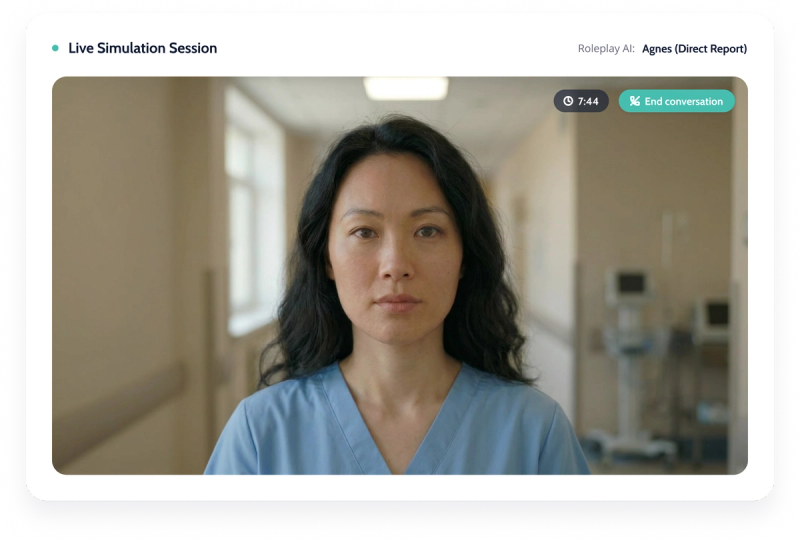
Immersive simulations turn learning into active participation. Employees can speak with an AI Virtual Human, respond to video-based scenarios, and choose from different actions. Branching paths show how each decision changes the outcome. This creates realistic practice without the scheduling, cost, or risk of live role-play.
AI-powered learning simulations are adaptive digital experiences that use artificial intelligence to change scenarios, responses, or difficulty according to learner behavior. They support personalized learning at a scale that traditional instruction often cannot provide.
Why realistic practice improves retention
Active learning helps employees connect knowledge with action. They do not simply remember what a policy says. They practice applying it in a context that feels familiar. They can repeat difficult moments until the right skill becomes easier to use.
Research on immersive learning links realistic, interactive experiences with stronger understanding, confidence, and knowledge retention (Source: How Immersive Learning Improves Knowledge Retention). One enterprise training guide reports 2–3x better retention rates than traditional methods, though results vary by program and measurement approach (Source: Training Simulations: Complete Guide to Immersive Learning Technologies for Enterprise Teams).
AI also makes practice more responsive. Simulations can adapt to an employee’s answers, identify decision errors, and measure skills beyond self-assessment or knowledge checks (Source: How AI-Powered Simulation Training Is Redefining Workforce Readiness).
Virti’s no-code platform helps enterprises create and deliver this learning consistently. Teams can build AI-powered scenarios without specialist development resources. Employees can access them on desktop, mobile, or VR, with support for global and distributed teams.
In 2026, effective training means measuring more than completion rates. Organizations need evidence of improved skill, retention, confidence, and business performance.
AI-driven immersive simulations improve high-volume training by combining realistic practice, timely feedback, and measurable performance data at enterprise scale.
Training simulations are structured scenarios that reproduce a workplace task so learners can make decisions and see results before applying the skill on the job. In high-volume programs, training simulations support consistent delivery, customization, and faster readiness.
How do AI simulations support scalable skill development?
AI-powered learning simulations can deliver the same learning objective to thousands of people while tailoring the conversation to individual responses. This creates a supportive learning environment for new hires, experienced staff, and distributed teams.
An ai-driven simulation can evaluate communication, judgment, sequencing, empathy, and problem-solving. The system can provide real-time feedback, recommend a customized next scenario, and record learning outcomes for managers.
Simulation-based learning is learning through decision-making, action, reflection, and repeated application inside a controlled scenario. It can improve training effectiveness because it connects a digital experience with the behavior a role requires.
The value of simulation is not immersion alone; it is the measurable transfer of better decisions into real work.
AI-powered simulations also support ai-driven team training by giving every participant access to consistent scenarios and comparable evaluation criteria. This improves effectiveness while allowing customization for region, role, language, and risk level.
Why realistic practice improves employee performance before the stakes are real
Realistic training simulations let people test decisions safely before those decisions affect customers, patients, colleagues, revenue, or compliance.
Employees rarely build confidence by reading a policy once or clicking through slides. They improve when they make decisions, see the results, and try again.
That is why many learning teams ask, how can ai-driven immersive simulations improve employee performance and knowledge retention for high-volume training? The answer starts with realistic practice. Employees can rehearse challenging situations before those moments involve customers, patients, colleagues, revenue, or compliance risk.
Practice judgment in a safe environment
Immersive simulations can recreate difficult conversations, customer interactions, sales objections, leadership moments, and regulated processes. Employees can test different responses without real-world consequences. They can also make mistakes that reveal gaps in judgment, communication, or procedural knowledge.
Research on six workplace examples found that immersive learning lets employees decide, fail, reflect, and improve safely. This approach supports stronger knowledge retention through experience, rather than passive instruction. (Source: Immersive Training in Action – Featuring 6 Examples of Immersive Learning in the Workplace)
Immersive practice means applying knowledge in a realistic situation, not simply recalling information during a quiz.
- Realistic simulations help employees rehearse high-stakes conversations, decisions, and procedures before facing real-world consequences.
An employee might practice responding to an angry customer, handling a pricing objection, or raising a safety concern. A new manager could address poor performance or deliver difficult feedback. In regulated roles, employees can follow required steps until the process feels familiar.
Build skill through dynamic interaction
Traditional e-learning often follows a fixed path. The learner selects an answer, receives a response, and moves forward. That format can test recall, but it may not prepare people for unpredictable human behavior.
Virti’s AI Virtual Humans create more dynamic role-play experiences. They can respond to what an employee says, change the direction of a conversation, and introduce new challenges. Employees must listen, think, communicate, and adapt. These skills are difficult to build through predictable click-through exercises.
- AI Virtual Humans turn training into responsive conversations, helping employees build judgment, communication, and problem-solving skills.
The learning loop is simple: repeat the scenario, receive feedback, adjust the response, and try again. This is deliberate practice. Over time, the desired behavior becomes easier to remember and apply under pressure.
- Deliberate practice strengthens performance by turning feedback into repeated improvements employees can use on the job.
For high-volume roles, this consistency matters. New employees can ramp up faster because they gain hands-on experience before serving customers or managing live cases. Experienced employees can refresh critical skills without waiting for an annual workshop.
That explains how can ai-driven immersive simulations improve employee performance and knowledge retention for high-volume training: they connect realistic decisions with repeatable learning and measurable feedback. Training becomes more than content delivery. It becomes a safe rehearsal for real performance.
Realistic simulations help employees become more confident, consistent, and ready before the stakes are real.
AI-supported training simulations can also make adaptation part of the learning design. If a learner performs well, the scenario can become more complex; if the learner struggles, the system can provide a tailored prompt or simpler decision path.
This adaptation supports enterprise skill development because teams can train common standards while still responding to individual needs. It also makes ai-driven team training more effective for mixed-experience cohorts.
how can ai-driven immersive simulations improve employee performance and knowledge retention for high-volume training through feedback?
AI-driven immersive simulations improve performance when feedback is immediate, specific, and connected to the learner’s decision.
High-volume training often creates a visibility problem. Course completion shows who attended, but not who can apply the right skills. Managers may miss weak responses, skipped steps, or knowledge gaps until they affect quality, conversion, compliance, or customer experience. Learners also receive feedback too late to correct mistakes while the scenario is still fresh.
The direct answer: AI-driven simulations improve performance by giving immediate, personalized feedback after each response. They show what a learner did, why it mattered, and how to improve. This makes practice more focused and helps employees retain knowledge through repeated, realistic application. That is how can ai-driven immersive simulations improve employee performance and knowledge retention for high-volume training at scale.
Turning simulation activity into useful insight
Feedback analytics are data from practice that reveal performance patterns, not just completion. A simulation can identify missed behaviors, weak answers, poor questioning, or incorrect decisions. AI Virtual Humans can also respond to each learner’s choices, creating a more realistic practice experience.
For example, a sales learner might mention product features but fail to uncover customer needs. A service employee may follow the script but miss an empathy statement. A leader may avoid a difficult conversation instead of addressing the issue directly. The learner can review these moments and try again.
Immediate feedback helps close the gap between knowledge and action. It also supports long-term retention because employees correct mistakes during learning, rather than relying on memory later. Repeated practice in AI-driven scenarios can build confidence and stronger workplace skills (Source: How AI Simulation Is Changing Workplace Learning).
Real-time feedback is guidance delivered during or immediately after a scenario, allowing a learner to correct behavior before the lesson is forgotten. This makes ai-powered learning more effective than delayed evaluation alone.
Comparing performance and targeting practice
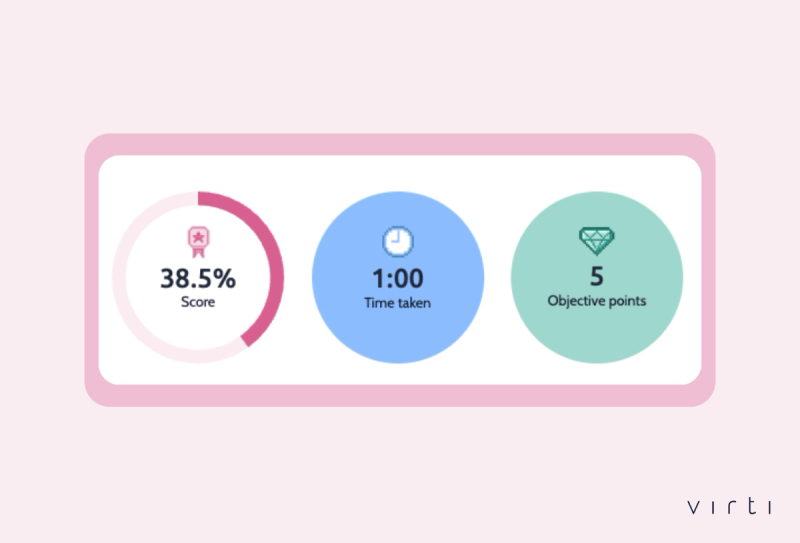
Objective scoring gives managers and L&D teams a consistent way to compare performance across teams, locations, roles, and training cohorts. They can track skill scores, response quality, scenario completion, and improvement over time. This reduces reliance on subjective observations or self-reported confidence.
These insights help teams assign targeted practice instead of repeating entire courses. An employee with strong product knowledge but weak objection handling may need one focused scenario. Another learner may need practice with compliance steps or customer communication. AI can adjust scenario difficulty to match each learner’s proficiency (Source: Immersive Learning: How Simulation-Based Training Transforms Employee Development).
This creates a repeatable create, learn, analyze, and scale loop:
- Create: Build no-code scenarios around critical workplace skills.
- Learn: Let employees practice safely across desktop, mobile, or VR.
- Analyze: Find knowledge gaps and behavior trends.
- Scale: Expand targeted practice across global teams.
For 2026 training programs, this loop connects learning data to business metrics. Leaders can test whether better practice improves quality, conversion, customer experience, compliance, and time to proficiency. The result is a proven path from simulation activity to measurable performance improvement.
AI-driven immersive simulations turn feedback into focused practice, helping high-volume training improve skills, retention, and business results.
AI-powered learning simulations can further support transfer by identifying whether a learner applies the same skill in a new context. For example, a customer-service scenario can test empathy with an upset customer, a billing dispute, and a vulnerable customer.
This kind of ai-supported analysis produces stronger learning outcomes than a single end-of-course score. It also gives managers evidence for coaching, remediation, and enterprise skill development.
The most useful feedback answers three questions: What happened, why did it matter, and what should the learner do differently next time?
How immersive simulations strengthen knowledge retention at enterprise scale
Simulation-based learning strengthens retention by requiring retrieval, application, reflection, and spaced repetition in a relevant learning environment.
TL;DR: AI-driven immersive simulations improve retention by making employees retrieve, apply, and revisit knowledge in realistic situations. Short, repeatable practice helps distributed teams build skills that last beyond a single training session.
Why immersive learning lasts longer
To understand how can ai-driven immersive simulations improve employee performance and knowledge retention for high-volume training, start with how people remember. Employees retain more when they actively use information, connect it to context, and revisit it over time.
Durable retention is the ability to recall and apply knowledge after training ends, especially under real-world pressure. Four learning mechanisms support it:
- Active recall: Employees retrieve an answer instead of simply recognizing it.
- Contextual learning: Employees connect knowledge to a realistic task or environment.
- Emotional relevance: Realistic stakes make the experience more memorable.
- Spaced repetition: Short practice sessions reinforce learning at useful intervals.
Branching simulations support active recall by requiring decisions. An employee might choose how to respond to an angry customer, select the next clinical procedure, or explain a product feature. Each choice changes what happens next.
This approach tests whether employees can use knowledge, not just identify the correct answer in a quiz. Mistakes also become useful learning moments because employees can try again without risking customer trust, patient safety, or revenue.
Immersive scenarios also add context. A policy becomes easier to remember when employees apply it during a simulated conversation. Product knowledge becomes more useful when a virtual customer asks an unexpected question. Skills become more durable when learning feels connected to the work itself.
Research supports this approach. Training simulations show two to three times better retention than traditional methods, according to IGIVU’s enterprise training review. (Source: Training Simulations: Complete Guide to Immersive Learning Technologies for Enterprise Teams)
Making retention practical at enterprise scale
High-volume training works best when practice fits real schedules. Five-minute interactive video sessions can reinforce one policy, product, or customer-service skill. Employees can complete them on mobile, desktop, or VR without blocking a full workday.
Spaced practice might include a scenario today, a variation next week, and a harder version later. This rhythm helps global and distributed teams build confidence without relying on one annual training event.
AI role-play makes repetition more realistic. An AI Virtual Human can change its questions, tone, and objections during each session. Employees therefore practice flexible communication skills instead of memorizing a fixed script.
Interactive video can reinforce compliance policies, product knowledge, clinical procedures, leadership behaviors, and service standards. Analytics can then show where employees struggle, helping managers assign focused practice rather than repeating every lesson.
This is how can ai-driven immersive simulations improve employee performance and knowledge retention for high-volume training: they turn learning into repeated, contextual skill practice that employees can apply when it matters.
The proven retention advantage of immersive simulations comes from repeated retrieval, realistic context, and targeted practice—not from simply making training more entertaining.
AI-supported learning simulations can deliver digital refreshers after onboarding, during product launches, or before an infrequent task. This creates a learning environment in which transfer is expected rather than assumed.
Virtual reality can add spatial context where physical layout matters. However, virtual reality is not required for every learning objective. Interactive video and AI role-play can deliver effective learning outcomes through widely available devices.
how can ai-driven immersive simulations improve employee performance and knowledge retention for high-volume training across global teams?
AI-driven immersive simulations support global scale when organizations standardize core objectives while allowing localized customization.
A scalable approach starts with business needs, not flashy technology. For 2026 planning, ask: Which employee behaviors must improve, and how will we measure success? This focus helps teams connect learning activity with real performance. Research on immersive experiences in employee development likewise highlights their potential to support scalable, engaging learning across distributed workforces (the role of immersive experiences in employee training and development).
What should global teams train first?
Prioritize skills that affect safety, revenue, service quality, or compliance. Then define a baseline and a target.
For example:
- Sales enablement: Raise qualified discovery-call scores from 65% to 80%.
- Customer service: Reduce escalation errors by 20% within 90 days.
- Leadership: Improve feedback conversations in quarterly assessments.
- Healthcare: Increase correct responses to patient-safety scenarios.
- Onboarding: Help new hires reach independent performance 15% faster.
- Compliance: Achieve 95% correct decisions across required simulations.
This is the practical answer to how can ai-driven immersive simulations improve employee performance and knowledge retention for high-volume training: they turn broad goals into observable actions. Learners can practice a skill, receive feedback, and repeat the scenario until performance improves.
Interactive experiences can also support stronger knowledge retention than passive content. Some industry research reports 2–3 times better retention with simulation training than traditional methods, though results vary by program and measurement approach.
Why does no-code authoring matter?
High-volume training changes often. Products, policies, regulations, and customer expectations rarely wait for a development queue.
No-code authoring means training teams can create and update scenarios without specialist developers or lengthy production cycles. A subject-matter expert can adjust a customer objection, add a new safety decision, or localize a leadership scenario.
A useful operating model includes:
- Build one core scenario around a priority behavior.
- Create three difficulty levels.
- Add regional language, policy, and cultural details.
- Review content with legal, compliance, or clinical experts.
- Publish updates through the same learning workflow.
Virti supports this create, learn, analyze, and scale loop with AI Virtual Humans, interactive video, and performance analytics. That allows teams to deliver realistic practice without rebuilding every scenario from scratch.
How can organizations scale access safely?
Offer the same learning objective through mobile, desktop, and VR. This supports office teams, frontline workers, remote employees, and learners with limited equipment. LMS integrations can place simulations inside existing assignments, completion records, and reporting.
Global deployment also requires strong controls. Evaluate whether a platform provides:
- Enterprise-grade security and ISO-certified controls
- Clear data retention and access policies
- Privacy-conscious AI usage
- Role-based governance and audit trails
- Human review for high-risk training content
- Accessibility and localization options
This framework shows how can ai-driven immersive simulations improve employee performance and knowledge retention for high-volume training without sacrificing consistency or trust.
The proven formula is simple: define measurable behaviors, enable fast scenario updates, provide accessible practice, and govern every learning interaction.
AI-supported localization makes training more effective for multinational teams. A tailored scenario can preserve the same enterprise skill objective while changing terminology, regulations, customer expectations, and cultural context.
This design supports enterprise skill development without creating disconnected programs for every region. It also improves engagement because learners recognize their own tools, customers, and working environment.
AI simulation training vs. traditional courses, live role-play, and VR-only programs
AI simulation training combines scalable digital delivery with adaptive interaction, measurable feedback, and repeatable skill development.
Choosing the right approach starts with the learning goal, audience, and scale. Passive courses can share information efficiently. Simulations help employees apply that information under realistic pressure.
The question how can ai-driven immersive simulations improve employee performance and knowledge retention for high-volume training becomes clearer when comparing the main options:
| Training approach | Best for | Strengths | Limitations | How it compares with AI simulations |
|---|---|---|---|---|
| Traditional e-learning | Policies, product knowledge, and basic compliance | Fast to deploy, easy to update, and simple to track | Limited behavior practice, personalization, and feedback | AI simulations add realistic decisions, conversations, and immediate coaching |
| Live role-play | Complex communication and leadership skills | Human nuance, emotional realism, and instructor guidance | Difficult to schedule, costly to repeat, and inconsistent across facilitators | AI Virtual Humans provide on-demand, repeatable practice with standardized scoring |
| VR-only programs | Safety, technical, and physical environments | Strong immersion and spatial learning | May require headsets, dedicated spaces, and specialized deployment | Virti supports mobile, desktop, and VR delivery, improving access across global teams |
| AI-driven immersive simulations | Sales, service, leadership, healthcare, and compliance practice | Scalable scenarios, adaptive responses, analytics, and safe repetition | Requires thoughtful scenario design and appropriate governance | Combines realistic practice with enterprise reach and measurable learning data |
| Bottom Line | High-volume, behavior-focused training | Use simulations for practice, feedback, and retention | Do not treat one format as the answer for every learning need | Combine simulations with courses, coaching, resources, and assessments |
Where simulations provide distinctive value
Traditional e-learning is useful for explaining concepts. However, watching a module does not guarantee that an employee can use those concepts during a difficult conversation. Simulations turn learning into practice. Employees make decisions, respond to realistic prompts, and see the effects of their choices.
This supports the wider goal of how can ai-driven immersive simulations improve employee performance and knowledge retention for high-volume training. Repeated retrieval and application can make learning more memorable. Immersive training research also reports stronger confidence and faster learning in VR-based experiences. (Source: Immersive Training: The Future of Learning with VR and AR)
AI Virtual Humans offer a practical alternative to scheduling live role-play. They are available across time zones and can repeat the same scenario for every learner. They can also adjust responses, assess skills, and provide immediate coaching. Instructors remain valuable, especially for nuanced feedback, group discussion, and high-risk decisions. AI expands their capacity rather than replacing their expertise.
Why platform access matters
VR can create powerful learning experiences, especially when movement, space, or physical risk matters. Yet VR-only programs may create barriers for large or distributed workforces. Headset procurement, device management, room setup, and technical support can slow deployment.
Virti’s cross-platform approach lets organizations deliver immersive video and AI role-play through mobile, desktop, or VR. This flexibility supports consistent training across locations and learner preferences. Its no-code authoring tools also help teams create and update scenarios without specialist development resources.
The strongest learning strategy is often blended. Use courses and knowledge resources to introduce concepts. Add simulations for behavior practice, then reinforce learning through coaching, assessments, and manager-led discussion. That combination answers how can ai-driven immersive simulations improve employee performance and knowledge retention for high-volume training without forcing every subject into one format.
Bottom line: AI simulations make practice scalable and measurable, while blended learning adds the context, coaching, and assessment that complex skills require.
AI training is most effective when it complements instructional design rather than replacing it. A strong design identifies the target behavior, creates a meaningful scenario, defines scoring criteria, and plans follow-up transfer activities.
Training simulations can therefore serve different purposes: onboarding, remediation, certification, leadership development, sales readiness, and safety preparation. The appropriate level of immersion depends on risk, audience, cost, and desired outcomes.
Key Takeaways
- Immersive training simulations improve readiness by letting people make decisions before real-world stakes are high.
- AI-powered learning simulations personalize difficulty, feedback, and scenario progression.
- Simulation-based learning strengthens transfer by connecting information with action and context.
- Real-time feedback helps learners correct errors while the scenario remains fresh.
- AI-driven team training gives distributed groups consistent standards and comparable performance data.
- Mobile, desktop, and virtual reality delivery can make high-volume training more accessible.
- Organizations should measure skill scores, time to proficiency, quality, compliance, engagement, and business impact.
- In 2026, effective programs combine AI training with human review, governance, coaching, and clear learning outcomes.
Frequently asked questions about AI-driven immersive training and retention
AI-driven immersive training uses adaptive scenarios, interactive media, and analytics to support skill development at scale.
How can AI-driven immersive simulations improve employee performance and knowledge retention for high-volume training?
AI-driven immersive simulations improve retention by turning passive content into active, repeatable practice. Employees make decisions, respond to realistic situations, and receive feedback immediately. This strengthens recall because learners connect knowledge with actions, not just slides or quiz answers. Interactive learning experiences also tend to increase engagement and confidence. Some industry research reports two to three times better retention than traditional methods, although results vary by program design and measurement. Virti supports this learning loop with AI Virtual Humans, video scenarios, practice, and performance analytics.
Can immersive simulations support high-volume training without requiring VR headsets for every employee?
Yes, immersive training can scale across large workforces through mobile, desktop, and optional VR delivery. This flexibility allows employees to complete the same simulations on devices they already use. Organizations can reserve headsets for situations that benefit from deeper immersion, such as clinical procedures or equipment training. Everyone else can practice through interactive video or AI role-play. That approach reduces hardware costs and scheduling challenges. It also supports remote and global teams across time zones. For leaders asking how can ai-driven immersive simulations improve employee performance and knowledge retention for high-volume training, cross-platform access is a practical starting point.
What types of employee performance can AI role-play measure and improve?
AI role-play can measure observable skills such as communication, questioning, empathy, decision-making, and policy adherence. It can also assess whether employees identify risks, follow a process, or explain information clearly. These measures help managers move beyond course completion rates. Learners can repeat a difficult conversation until their skill improves. For example, a sales employee might practice discovery questions, while a healthcare worker practices patient communication. Virti scenarios can provide structured feedback and analytics across teams. The exact measures depend on the scenario goals, scoring criteria, and business standards defined by the organization.
How does Virti help L&D teams create scenarios without specialized development resources?
Virti helps L&D teams create AI-powered scenarios through no-code authoring tools and reusable content. Teams can define a learning objective, add context, set evaluation criteria, and build a realistic conversation without hiring a development team. AI Virtual Humans then respond dynamically, rather than following one fixed script. Subject matter experts can update scenarios as policies, products, or risks change. This supports faster content creation and more consistent training across locations. L&D teams can create, launch, analyze, and scale learning experiences from one platform, while keeping human reviewers involved in quality and governance.
How can organizations measure whether simulation training improves business outcomes?
Organizations can measure impact by connecting simulation data with operational and workforce metrics. Useful measures include skill scores, repeat-practice rates, time to proficiency, manager evaluations, quality results, customer satisfaction, and compliance errors. Teams should compare baseline performance with results after training, using consistent groups and time periods. They can also track whether employees apply the skill on the job. This creates a clearer answer to how can ai-driven immersive simulations improve employee performance and knowledge retention for high-volume training. Virti analytics can help L&D teams identify skill gaps, compare cohorts, and focus coaching where it may affect business performance.
Are AI-driven simulations suitable for regulated industries?
Yes, AI-driven simulations can support regulated training when organizations apply strong governance, review, and data controls. Healthcare teams can practice patient conversations, escalation, and safety procedures in a controlled environment. Financial services teams can rehearse compliance discussions, risk identification, and customer interactions. Organizations should approve scenario content, protect personal data, document changes, and keep human oversight for high-risk decisions. Simulations should reinforce official policies, not replace legal or clinical guidance. Virti is designed for enterprise use, with security, governance, ISO certifications, and privacy-conscious AI practices that support responsible learning programs.
How do AI Virtual Humans differ from scripted chatbots or pre-recorded training videos?
AI Virtual Humans create responsive practice by adapting their language, questions, and behavior to each learner’s input. A scripted chatbot usually follows set paths, while a pre-recorded video delivers the same content every time. Virtual Humans can introduce uncertainty, emotion, objections, or follow-up questions that mirror real conversations. Learners can practice repeatedly without risking a customer relationship or patient experience. This makes simulations useful for building communication and decision-making skills. They do not replace expert coaching; they provide a scalable practice layer that helps employees arrive better prepared for real work.
The clearest answer to how can ai-driven immersive simulations improve employee performance and knowledge retention for high-volume training is simple: they let more people practice realistic skills, receive feedback, and apply learning before real-world stakes are high.